Tuesday, May 23, 2023

The Wonderful Life of Tommy Wonder


Today we are talking about Tommy Wonder, which was the stage name of Josef Jacabus Maria Bemelman, who also went by the name Jos Bema for a time. He was born November 29th, 1953 in Holland. At the young age of four, Jos saw his first magician. The event is chronicled in the 1994 issue of Magic Magazine. He saw a magician set paper on fire inside a pan and cover it and when the cover came off, the pan was filled with cookies. A prop commonly  referred to as a Dove Pan, but frankly is more of a utility device today. His enthusiasm led him to grab a newspaper, some matches, and a frying pan from the kitchen and attempt to create this miracle himself. His results were much the same as mine back when I tried to recreate the vanishing milk from paper cone illusion after having seen Tony Curtis do it in the Houdini movie. Suffice to say, his frustration, led his mother to explain that it was a magic trick. And thus was Jos’s first exposure. His interest would sway back and forth for a number of years, but by aged 10 he found his first magic book. Most of the biographical articles give age 10 as his official interest, but I think we can see it was aged 4. And then by 14 he joined a local magic club and really began to learn and study and grow. He entered contests and was showing himself to be quite the remarkable magician. From early on, Jos had this ability to work on creating his own effects. Yes, he would take things that already existed, but he would put his own ideas and own way of thinking into the routines. 


I went to Tommy Wonder’s website for more information on this period of his life. But suffice to say, his site is gone. But because I ‘know things’ I was able to dig it back up from the netherworld. not be be confused with the Netherlands, and was all excited to read his biography page. And sadly, not one word of his formative years. In fact, his biography was quite short.


In an article an article Max Maven wrote for MAGIC Magazine, and which is also in the opening of the Books of Wonder, he reveals that Tommy began to win contests from age 14 through high school. And he developed the famous trait that is the bain of all a performers existences, he began to get cocky, which is an exact quote. But Tommy soon discovered his cockiness and his abilities as a magician did not automatically lead to fame and fortune. That’s generally the lesson the follows cockiness. So he applied and was accepted into the Academic door Podium-vorming in the Hague. This was a performing arts school in which he attended for three years. According to his website, “Then he worked for 2 years with the theater company “De Haagsche Comedy” where his theater experience enlarged. 


The MAGIC Magazine article mentions that for a time Tommy Wonder teamed up with fellow Hollander, Dick Kornwinder. Together the two of them pitched a small item based upon the old mouse pitch. It was a bright colored piece of fabric that seemed to come to life and run through and over the performers fingers and hands. I don't seem a mention of them in the magic magazines of the times, other than appearing at conventions together, but no mention of what they are doing or even selling. No doubt one item they could possibly be selling would be the Card Finding Miniature Car that Dick Kornwinder created in the early 1970s and later sold to Ken Brooke. Ken, was the only authorized dealer, but before long they were being sold by many different makers. In the 1980s, Juan Tamariz made a splash on American TV when during a Thanksgiving timed Magic Special called The worlds greatest Magic, he presented the Card Finding Miniature Car. It was a huge hit in Juan’s hands and soon the phones rang off hook again for this amazing tiny car.


IN 1977, Tommy had created a stand up manipulation act. Fortunately for us, this was recorded on and is available to view online. The show was a talent contest called Plankenkaus and it appeared on Dutch TV.  The act, highly original material, though still it was still card manipulations, and billiard balls. The thing was, the card manipulations were unlike what anyone had seen. For example, a deck of cards is removed from a box and fanned out. A second later, the card box vanishes. It’s discovered in the other hand, with the cards BACK in the box. This is repeated several times with variations. 

Next he does a diminishing card effect, with again, his own original method. After this a ring and rope routine and then the conclusion is a billiard ball routine, where balls appear, change color, multiply, vanish and then a huge giant ball is produced. The methods and techniques during the billiard ball are mostly original with a touch of some standard moves. But the overall impact is amazing. If you watch the video, this appears as if it might be a magic convention, as Fred Kaps is in the front row watching Tommy’s performance.  the magic is fantastic, the burlesque stripper music is a tad annoying.


And then he came across Henning Nelms book, Magic and Showmanship. Reading the book and looking at his act, he quickly understood that this type of act was NOT who he was. Further, Tommy was soon to discover, that manipulation magic, as much as he enjoyed it, didn’t have much of a commercial audience, or if there was one, he didn’t know how to sell his act to them. Now, close-up magic, that he could sell and he did. Tommy’s creation for the close-up artist are incredible. In fact, he excels in this area, as much as he did in his stage act. 


In 1978, I found the first mention of the name Tommy Wonder. Jos Bema was announcing at the end of  his lectures that this would be his new name. And to anyone else, I would say, ‘its a terrible name, too easy to make fun of”. But for jos Bema, aka Tommy Wonder, it was the perfect name.


In February 1979, Tommy appeared in the pages of Pabular with his presentation of Coins Across. By the way, I’m going to put a transcript of this episode on my blog, TheMagicDetective.com and I’ll be posting the various videos that show the effects I’m speaking of. Tommy’s clever take on the Coins Across was his solution to not have to count and recount the coins from hand to hand every single time. With a small change in the plot, and the addition of a ‘magic coin’ unusual things happen. Please check out the video.


By the way, later in 1979, Tommy wrote an article for Pabular magazine about Standing vs. Sitting in a Close-up performance. This was a new way of thinking. If you recall, popular close up artists who came before him: Dai Vernon, Tony Slydini. Ross Bertram, Al Goshman, and others routinely were seated. Even today, Dani DiOrtiz, Juan Tamariz, David Roth have a tendency to sit, though they will stand on occasion. If you watch Tommy Wonders videos, you’ll see that during closeup routines. sometimes he sits, sometimes he stands, whatever works best for the routine. In his Magic Ranch routine that he describes in his Books of Wonder and which is also available online, standing is most important to the routine.  In his essay, he makes some brilliant points about standing, one of the most important is the fact that the tallest object in the room gets the eyes. IN his words, “Being higher than the audience bestows a more important appearance and gives you added authority, making it easier to command the situation.”


Sometime in the mid 1980s, Tommy received a request from a restaurant with a medieval theme. They wanted to know if he could create a custom show for their restaurant. Now this was not your typical restaurant gig, where you stroll from table to table doing magic. This was a stage production. It took Tommy six weeks to develop the material. It was so successful that he stayed at that restaurant performing for 5 years. His original contract was for 50 weeks of work.  And this material became his new stage act. In 1988, he took time out of his schedule to perform at FISM and won the 2nd place prize for General Magic. And according to Magic Magazine August 2006, he proceeded to throw-up everywhere after the competition. The nerves and the stress got the better of him. He vowed that would be his final FISM entry. 


This restaurant gig really forced him to delve deep into his theatrical training. 

If you consider his stage act, it is presented as a period piece, quite theatrical in nature. There is a whole story going on there from start to finish if you pay attention. Quite different from what other magicians of the time were doing. It was very standard practice to go from trick to trick, sometimes connected, sometimes not. But in Tommy’s stage act, one magical moment leads to the next, in a logical progression. At the conclusion of a very non-standard cups and balls routine he ends up with a lemon, an egg, and an orange. He then attempts to make them vanish, starting with the egg, but a bird in a cage that is sitting on a high stand on stage, begins to make a commotion when he picks up the egg. This leads to him covering the cage with his cummerbund, and more noise from the bird. The cage rattles around leading to yet another magical moment, and another and another. Brilliant. Tommy is dressed in some sort of colonial period costume, yet his table is very modern and thin and does more to help sell the visual illusion of impossibleness than anything. Clearly nothing is hidden in the table! 

One thing I found unusual when I first witnessed his Cups and Balls, the stage version was the fact that two cups were the same size and one was same design but larger. Well, I discovered in the Linking Ring Magazine, Sept 1987, where Tommy mentions that in the medieval times, they used two cups of the same size and one different, this was based upon paintings he had seen of Cups and Balls performers. And from an August 2006 MAGIC Magazine interview with Tommy Wonder, I learned that Richard Ross, the great manipulator, help Tommy with his stage act.


Somewhere among the years, I saw Tommy Wonder present his Vanishing Bird cage. This is a personal favorite of mine. So many performers have used this prop and all with different degrees of success. Probably no one more recognizable with the cage than Harry Blackstone Jr. He would walk out on stage holding the red ribbon covered brass cage. After uttering the line, “IN a moment this cage will vanish from my fingertips and you’ll not see where it goes!” And then, a second later it was gone. He’d go backstage for another cage and ask for more volunteers to help him on-stage. This time the volunteers, all children, put their hands on various sides of the cage and as he is instructing them, their hands collectively fall into each other because the cage vanished.


Next we have Billy McCombs hilarious version with the mouse who EATS the cage whole! He stuns his audiences at how the cage vanishes in slow motion. Unreal.


Then there Jonathan Pendragon, who had his sleeves rolled up and didn’t seem to move and the cage instantly vanished. Finally, there was Tommy Wonder’s. He doesn't start holding the cage. He picks it up and it seemed to be solid, not flexible or moveable. His sleeves rolled up……and without any movement, the cage just vanished!!!! A site to behold..or not behold! as it were.


Tommy now had an award winning stage act, an award winning close-up act, and he wasn’t finished. In 1996, he wrote, along with Stephen Minch, and published through Hermetic Press, his two volume Books of Wonder. I recall when these became available. I went straight to Denny’s Magic Shop to buy my copies. I was most curious about his vanishing birdcage, but then I quickly was caught up in all his articles on the theory of performing, or perhaps it’s better to call them his philosophy of performing. The Books of Wonder recently have been reprinted and are available through various magic shops online. They are a must have. 


In May of 1996, Tommy Wonder appeared on the cover of The Linking Ring with a short biographical article. In June 1996, he appeared on the cover the Genii magazine, but this time, a short piece by Jamy Ian Swiss talks about his first exposure to Tommy’s magic and later meeting and getting to know him. This is followed by 4 articles directly from The Books of Wonder.


In 1997, Tommy won the Performers Fellowship award from the Academy of Magical Art


Maybe you are wondering, what was he like? What was Tommy Wonder like in real life? From the research I just did, and from the videos and through a couple interviews I’ve read, I think I can safely say he was a man who truly believed in magic. He felt we all had our own inner magic and needed to discover it for ourselves. Though he wrote 2 of the greatest volumes on magic, he would not consider himself a teacher. He didn’t think people could be taught magic. They had to find it for themselves. That might sound strange, but what Tommy was speaking of was much deeper than knowing how to do a magic trick. You can teach someone to do a trick, sure. But I believe, and he certainly believes, there is much more to magic than just knowing how a trick works and even being able to perform it. There are levels to a magic trick that we cannot even fathom until we have performed it many times. Only then can we begin to understand the magic, and only then can we tweak it and twist it into the ultimate mystery. You’d think with the Books of Wonder that Tommy was satisfied with his magic, that many of the routines in the book were completed works. But the opposite is true. He was always working to improve, perfect, alter his works. A great example is a routine called was a trick called Elizabeth. In the books of Wonder, it’s called Elizabeth III. It began  as a dealer item sold by Davenports of England called Elizabeth’s Fantastic Joker. It was a card prediction that used a piece of apparatus to create the magic. In the Pabular magazine, a magician named Wally Boyce published Elizabeth Second, which was his version of the effect, streamlining things. Tommy chose to take things even further and thus the name Elizabeth the Third. But it didn’t stop there. When L&L created the Tommy Wonder videos, Visions of Wonder, it includes a routine called Elizabeth the 4th, so again, Tommy was working to make the magic better and better, even after having published his great two volume set.


This is another trait of his personality. Passion. Clearly he was passionate about magic and about the process of magic. He thought about it on a deeper level than a lot of people do. I recall on the Visions of Wonder videos when Tommy does his Next of Boxes routine and Max Maven is watching and commenting, he is totally blown away by the methods and the thinking that went behind it. For Max to have this opinion speaks volumes.


In November of 2005, Tommy Wonder received a diagnosis from his Doctor that he had lung cancer. Initial treatments seemed promising. But then, things began to take a bad turn. In the September 2006 issue of Genii Magazine, Stephen Minch, co-author of The Books of Wonder, tells the story of traveling to Holland, along with Max Maven, to visit Tommy in his last days. It's a difficult read because he shares his fondness for the man, how their friendship developed, and knowing this trip would likely be the last time they saw Tommy. The visit clearly cheered up Tommy. Visits by other friends would barely last two hours, but on this visit, Tommy was awake alert and engaged for 6 hours. He felt revigorated. They spoke of magic and friends in magic. They avoided the topic of his illness, as there was really nothing more that could be said. 


On June 26, 2006, Tommy Wonder, Jos Bemelman, passed away at the young age of 52.


As I worked on this particular piece for the podcast, I feared I wouldn’t find enough material to make a full episode. Besides a couple biographical articles in Magic and the Linking Ring, there wasn’t much out there on his life. But I kept pushing forward, kept watching his magic, kept reading the Books of Wonder. 


Then I came across this interesting ‘letter to the editor’ in OPUS Magazine. Tommy was speaking about something he had read in an article by Ian Keeble. It was something he disagreed with and wanted to add his opinion to the discussion. A couple months later, Terry Seabrook wrote a piece in Opus about Tommy’s letter and basically said, “I disagree with everything he had to say.” Let me also say I think they all were entitled to their opinions and I think a case could be made for each opinion being correct...


The basic point of it was Tommy disagreed with the idea that you should do things your audience wants to see. Give them what they want! In other words. Terry Seabrook put it pretty bluntly when he said, ‘Tommy considered himself a magician, while I consider myself an entertainer’. and at the end of the day it is easier to pay the bills as an entertainer because I’m giving my audience what they want, a laugh, a smile, a few minutes to forget about life and be entertained. Yep. that makes sense.


In Tommy’s letter he says, “He has learned that it’s better to do what you love to do. Audiences in the end want to know about You, and by doing what you love it reveals more about you.” A radical way of thinking in the 80s when he wrote that letter. But now, all these many years later, in the 21st Century, I’m reminded of how many people say that we should reveal ourselves in our shows. Let the audience get to know us. Reveal something about us. Hmmm, was Tommy Wonder onto something?


Tommy also points out in his letter that Vincent Van Gogh, could have painted like all the other painters of his time, and likely sold a bunch of paintings. But he had his vision and he painted what he wanted. Sadly, this meant he sold a whopping 1 painting while he was alive. But since his death, his paintings have brought in millions upon millions of dollars. It’s a risk an artist in any field has to be willing to take. 


My favorite thing I learned about Tommy Wonder came from an interview he did with carlos Vaquera. Tommy is asked, “If you had to choose a single word that represents magic for you, what would it be?” And Tommy’s response. Beauty. 


In that I think we learn all we need to know about Tommy Wonder. A man who truly lived up to his name. 


(this is a transcript from Ep 91 of The Magic Detective Podcast)


Monday, April 10, 2023

A Visit With a Houdini Collector & Magic Historian


I had the honor of visiting my buddy Wayne Alan this past weekend. Wayne is the owner of the Old North Theater in Danville VA. He is also a semi-retired illusionist and very busy magic historian. I don't think he considers himself a collector, but man does he have some crazy cool stuff!

For example, the photo above are sections from the Old Keith's Theater in Washington DC where Houdini did a hanging straitjacket escape in 1922. Wayne also has the air grate that was in Houdini's hospital room in Detroit. 

In addition, he has documents, audio recordings and artifacts that will make your head spin. And I'm sadly, not at liberty to divulge. I got to see and touch and item that belonged to a very famous magical artist from yesteryear. Again, can't say yet who it is because Wayne plan's to do a big reveal at some point. 

If all the Houdini stuff wasn't enough, Wayne has some Doug Henning items. He owns the Lion's Bride Cage, and he owns a sawing in half that was Henning's. Apparently, some claim it's not Henning's but Wayne say's it is. I saw it. Label is clearly from Owens Magic to Doug Henning. Stencil on the side says The Magic Show. And inside is a Sawing in Half. There are two cases for it.

There must be a story that goes with this, as it's not the Sawing is featured in the promotional photos. But it is without a doubt a Sawing in Half, that Henning owned and does have 'The Magic Show' stenciled on the case. Plus, the case is appropriate for that time period.  We did not put the entire thing together, but it was cool to see.

Wayne is intending upon building a Museum of Magic next to his theater and he has a building that is perfect in which to do it. I can't wait to see the finished thing, it's going to be spectacular.


Tuesday, February 7, 2023

Another Doug Henning Anniversary, This time #23


February 7th, 2000, Doug Henning passed away. He was only 52 at the time. It came as a huge shock to the magic community for several reasons. For one, he was way too young to pass away. But secondly, he had started to get back into magic just prior to this. He had been spotted at several different magic shops and had some communications with old friends in the magic world. Some even speculated that maybe, just maybe, he was going to make a come back.

But that was not to be.

Magic was very different 23 years ago. Ok, maybe not VERY different, but different enough. I guess I'm thinking of when Doug was around and performing. New strides in the world of Illusion were happened, they started with Doug and then when he left, they continued with David Copperfield primarily. The man behind those innovations was Jim Steinmeyer. But he wasn't the only one, Andre Kole was creating incredible illusions, as well others.

Just this past weekend, I began to explore the world of one of the guys who worked with both Doug and David, his name is Doug Bennett. I recalled the name, but wasn't aware of this many contributions. In fact, as I type this, I have a friend working on a jumbo version of a trick Doug Bennett created called The Criss Cross Deck. Doug featured it on one of his TV specials. 

Doug Bennett is probably best known of his Bewildering Effect, that Doug Henning featured on a Tonight Show spot with Johnny Carson. And there is another effect he created called FireTrap, which again, Doug did on a TV spot. It was cool to discover that Mr. Bennett is still working in the magic world. as a consultant. HIs latest commercial item was a Floating Selfie Stick, ala. Dancing Can....brilliant. If you'e like to learn more about Mr. Bennett, check out http://www.dougbennettmagic.com/magicconsulting.php

And please take a moment or two to remember Doug Henning and his unique brand of magic.

Wednesday, February 1, 2023

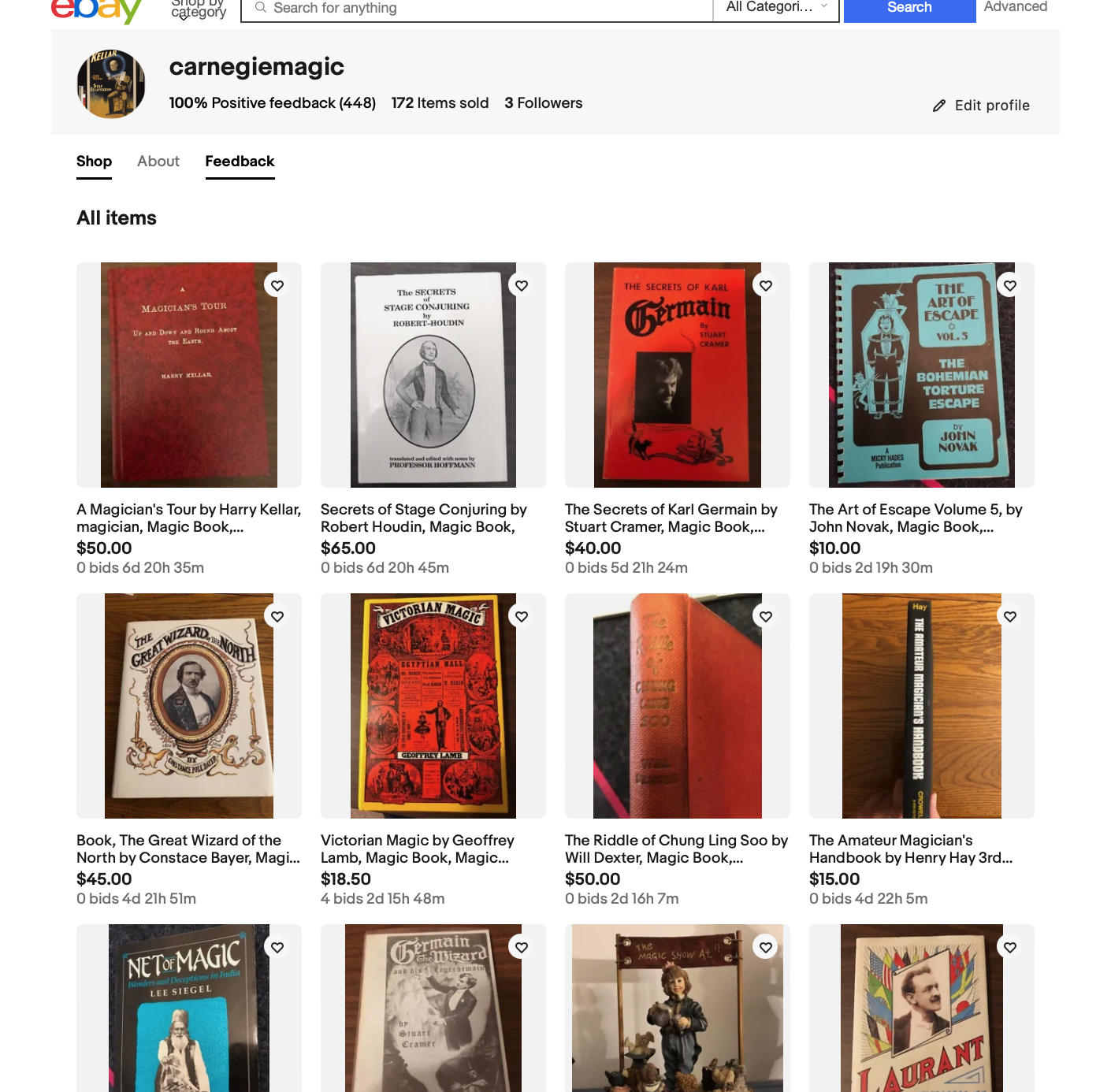
Selling Magic History Items on EBAY!!!


Here it is, selling off my collection! Wait, no. LOL. I'm only selling a few items that I have extras of. Fortunately, I have a lot of duplicate items and in some cases several additional of a particular thing. I'm putting up magic history books, ephemera, posters, brochures, bobbleheads, magic figurines. 

Right now there is a vintage Virgil & Julie Poster which will likely sell in two days. I have another one that I haven't posted yet. I've got a couple Raymond items I may put up. Get them while they last. 

Here is the link to my ebay page..  https://www.ebay.com/usr/carnegiemagic 

Sunday, January 15, 2023

Penn and Teller Return!

There was a time in the 1980s when this duo, Penn Jillette and his partner Teller, where known as the Bad Boys of Magic. By all accounts, they were like anti-magicians, exposing tricks and infuriating the world of magic while making cockroaches and snakes and who knows what appear all over David Letterman's desk!

They didn't do the ordinary coin tricks, stage illusions, or anything regular magicians did. Oh, well they did the Cups and Balls....and then exposed it brilliantly after performing it. No, they conjured with BEES, BUGS, BLOOD, all manner of craziness. They did magic upside down. They did magic underwater!

They've had a long career. And then 30 years ago, on Jan 14th, they began to perform in Las Vegas. They are now the longest running comedy act in Las Vegas History! They may just be the comedy act that lasted the longest. Martin and Lewis, Abbott and Costello, and others all broke up. Penn and Teller, still together!


In Oct 2022, Teller, took a break from the show to undergo bypass heart surgery, no small feat for a young person, but Teller is 74. He came through with flying colors and if I might add, I think it proves he is indeed a YOUNG 74! On Jan 14, 2023, Penn and Teller once again united on stage of the RIO Casino in Las Vegas to continue their stellar run. And get this, they opened with new material and announced they would be debuting more new material.

This is one of the reasons Penn and Teller are so magnificent and so incredibly GREAT for the World of Magic. They do not rest on their laurels. They continue to put out new material. And their stuff is killer. They have more original routines than probably any magic act around.  And I've not even mentioned their TV Show which is the greatest platform for great magic, EVER!!!!

I can say one thing. LONG LIVE PENN & TELLER!!!!

Tuesday, December 27, 2022

Charles Dickens: The Amateur Conjurer Corrected


Episode 86 of The Magic Detective Podcast was on Charles Dickens and the fact he was an amateur magician. I will admit to being a bit rushed to get that episode out. I wanted to have it out before Christmas Eve and I did, but only by an hour or so. And because of that, it looks like I made a few errors.

Ian Keeble, who I mentioned is an authority on Dickens as a Conjurer, and is the author of the book, Charles Dickens Magician: Conjuring in Life, Letters, and Literature, reached out to me in regards to my podcast on Dickens. He was kind enough to point out a few errors I had made and provided the background and reasoning behind the mistakes. Basically, I was not the first person to make these mistakes, they were mistakes magic historians and writers made before me, and I just passed them along.

I'm going to attempt to re-record the entire episode with the correct information. However, if I'm not able to do it without loosing the stats from those who already listened, then I'll have to pass on it. I'll be contacting my host company to see what can be done.

In the mean time, for historical accuracy, I'm putting the errors and corrections here.

1. The supposed connection between Ramo Samee, Dickens, Nicholas Nickleby and Hull in 1838 was first made in the magical press by Frank Staff in The Magic Circular in 1929 (the original 'spot' was made in The Dickensian, 8 years previously). It was picked up by JB Findlay in Charles Dickens and his Magic (1962) and also by Eddie Dawes in The Great Illusionists (1979). It was actually Trevor Dawson in his book Charles Dickens: Conjurer, Mesmerist and Showman, 2012, that demonstrated Dickens was in London at the time (which I have also checked out). So a relatively recent discovery that it is highly unlikely that Samee played any part in Dickens taking up magic.


2. How Clarke, in Annals of Conjuring, came up with Eugene Bosco as the name of the magician Dickens saw in France in 1854 is not known. Clarke did admit that he wasn't completely sure it was him. It was, ironically (given his error above), Frank Staff who cracked the name as being Alfred de Caston in another article in The Magic Circular in 1931. I have subsequently compared what de Caston did according to Dickens (he gives a very accurate description of his repertoire) with his tricks from other sources; and it is quite clear that it was de Caston.


3. The article which was supposedly written by Dickens about Robert-Houdin was called 'Out-Conjuring Conjurers'. It appeared in Household Words, vol. XIX, no. 472, 9 April, 1859 and was a review of Robert-Houdin's Memoirs. The review came out before the English edition was published, so the reviewer must have read it in French. I think the first assumption that the article was by Dickens was made by Will Goldston in Goldston's Magical Quarterly in 1934. The article you probably saw was from The Sphinx, November 1938: this reproduced parts of the article with the heading 'About Robert Houdin by Charles Dickens'. 


This myth has long been sustained, including by Ricky Jay (Celebrations of Curious Characters) and Jim Steinmeyer (Hiding the Elephant) - so you are in good company! The true author was actually first revealed in the magic press by Stephen Tigner in his short-lived The Journal of Magic History (1979 - the revelation was made in an undated supplement). No magic historian (Jay actually references the original Tigner article, but apparently didn't see the subsequent supplement) seems to have spotted that, including Trevor Dawson in his 2012 book Charles Dickens: Conjurer, Mesmerist and Showman. Dawson incorrectly claims that Dickens didn't only write this article on Robert-Houdin; but also many other articles which have magic references in them. In reality Dickens didn't write any article directly about magic; although he wrote two or three about spiritualism. He had a particular dislike of Daniel Dunglas Home.


'Out-Conjuring Conjurers' was actually written by the Reverend Edmund Saul Dixon. If you read the article, it's in fact pretty boring: doesn't have any of the flair of Dickens' writing so prevalent in his own articles.


And there you have it. The errors and the corrections. I am so grateful that Mr. Keeble took the time to explain all this. If I had more time when writing my article and IF I had Ian's book in hand, which I don't have, I likely wouldn't have made as many of the mistakes.  One thing I can say is that information that appears in The Sphinx magazine is often wrong. I find this time and again when researching a particular subject. And because that info is wrong, much of what is in David Price's book is wrong. This then leads to a detour in the research, just to discover the correct information.  But we are all human, and we make mistakes. And frankly, I love the research, so even though the source material was incorrect, it was still great fun to work on. And It's nice when the record is corrected for future researchers, so thank you again Ian Keeble. 

Sunday, December 11, 2022

News on the Magic Detective Podcast


Season 5 of the Magic Detective Podcast is will underway. I'm actually on track for once. I expect to have two more podcasts in December which will put the total at 6 episodes, which is half as many as I did in Season 4. I only got at total of 12 out in Season 4. Season 3 wasn't much better with only 13. I'm really trying to get at least 20 episodes per season.  

The next episode is going to be a very special holiday episode, #86. Then the final episode for 2022 will be another broadcasting of a Radio Interview I did on the history of magic. This one I did back in October of this year. 

I'm really behind in some of my plans for the podcast. I had expected to have my t-shirts up and available by now, but that hasn't happened, and sadly may not. I've fallen behind on the contests, which were always popular in the past. And I have yet to get another interview done. So my total stands at ONE, lol. That interview was with my friend Judge Gary Brown who wrote the book on Al Flosso. It is the second most listened to podcast of the entire run. I don't want to have a LOT of interviews, but I do want to include some.

I have been asked a number of times if I plan to continue the podcast. I guess that's because I've had trouble getting out new episodes. The answer is yes. I have a master list of 200 potential subjects to cover on the podcast. I've already done 85 of them. BUT, I'm always adding to the list. For example, Episode 85 was Milbourne Christopher, who I had never put on the list, and I'm so glad I did! I'd say the unfinished podcasts stands around a constant 120, because I get some done and then I add some, so it sorta stays around the same number yet to get done. And right now, if I only do the remaining ones, I've still got 6 years left on this. That's probably longer than most podcasts stay around.


Sunday, November 27, 2022

The Strange Phenomenon of Photographing Ghosts


Photography began back in the 19th Century. I'm sure to folks of that time, it was as amazing to them as computers are to us. Photography of the 19th Century was very primitive by today's standards. It was due to this primitive technique that a Boston Jewelry Engraver named William Mumler, accidentally stumbled upon the ghostly image of a cousin who had died 12 years previously. This was in 1862. Mumler showed his photos to others. He swore that his process was legitimate and that these images were of authentic spirit images. As you might imagine, he created both believers and skeptics. The skeptics felt that what he was doing was some sort of trick. The believer felt they were seeing a ghostly image. 

Keep in mind, as we look upon these images today, we can tell how fake they are. But people of the 19th and early 20th centuries had nothing to compare it to. It's kind of like when a movie comes out with new special effects and we think about how great it is. But soon many movies use the same tech and we are then able to critic CGI and other methods.

Back in the late 1860s,  a NY Supreme Court Judge, upon seeing these so called Mumler Spirit Photos, went to NY with the intention of shutting Mumler down for fraud. But as it turned out, the gentleman, after seeing the process came away a believer!

In April of 1869, Mumler was brought to trial for Fraud. A major skeptic, and one who testified in the trial against William Mumler was P.T. Barnum, the great circus showman. Barnum took offense to this type of deception and worked feverishly against it. I guess not all humbug was the same in Barnum's world. And in fact, there was innocent humbug and offensive humbug, the latter was trying fool grieving people into believing they could talk to dead relatives. As it turned out, Mumler was acquitted of the charges.


But why was he acquitted of the charges if what he did was clearly fraud? Because, his methods were not so obvious. He had actually developed a system which would later become known as The Mumler Process. And this term was used outside of the spirit world. Mumler's process allowed for what is called 'photo-electrotype' plates. The best description comes from the book, The Apparitionist by Peter Manseau, "the Mumler process, as it was known, allowed printers to forgo the usual step of having a photographic plate copied by hand by an illustrator or wood engraver, revolutionizing the ability to reproduce images by the thousands." In other words, we have Mumler to credit for newspapers and magazines being able to print photographs rather than woodcuts or drawings. 


Mumlers most famous spirit photograph was taken in 1872. A woman, dressed in black, turned up at this studio. She was the widow of Abraham Lincoln, Mary Todd Lincoln. This particular photograph would be the last known photo taken of Mary Todd Lincoln, and would be Mumler's most iconic. Mary Todd was known to be a true believer in Spiritualism and remained so all her days. Her photo remains one of the better and spookier images to ever be produced.

Another individual who also stumbled upon a process for making spirit photos was William Hope from Cheshire England. He developed his first spirit photo in 1905. He soon started his own Spiritualist Church. His procedure was wrapped around saying prayers, singing hymns and then eventually taking the photos. Wrapping the whole thing in a religious ceremony would certainly make him different than many of the other photographers who took such photos.  Hope was so impressive with his photos, he fooled famed investigator and scientist William Crookes. Eventually, however his methods were exposed and he was revealed to be a fraud.


Spirit Photography has gone through its phases of popularity, as has Spiritualism. A few years after the Civil War, it was on the decline. But during and after WW1, Spiritualism began to rise again due to the number of deaths during the war. Families desperately wanted one last word with loved ones, and Spiritualism and mediums apparently offered this opportunity. In comes, Harry Houdini. And actually, it was during this time that Sir Arthur Conan Doyle was involved as well. Sir Arthur Conan Doyle, creator of Sherlock Holmes and avid believer in Spiritualism. In Doyle's eyes this was another example of proof. Sir Arthur could be relied upon to be duped by just about anything. He was no Sherlock Holmes in real life.  In 1922, Doyle published a book called, The Case For Spirit Photography, complete with a cheesy Spirit Photo on the cover of the book.

Houdini on the other hand recognized fraud. In fact, he set up shop in his own home to be able to produce his own Spirit Photos.  I'll say for not being a professional photographer, Houdini's Spirit Photos are as good as any. A few of them, even better than the average. One of his most iconic, also utilized Abraham Lincoln. There are numerous versions of this one. In one he is holding a book and looking at Lincoln. In another, he has his wrists handcuffed. In yet another he has his hands tied. Strangely, Lincoln never changes his pose, but remains the same in every picture. By today's standards we can tell it's faked, but I'm sure it was impressive in his day. 

I think my favorite of the Houdini spirit photos is the one below. There is another that I like which is a close runner up, you'll find that one below this spooky one. Both of them were taken inside Houdini's home in Harlem. Of course, Houdini, being the great debunker, and including an expose of fake spirit mediums methods in show final show, helped to squash the fad of spirit photos. In 1924, Houdini wrote his book, A Magician Among the Spirits, which he systematically exposes the various characters and methods of the Spiritualism movement. The first photo in the book, is of Houdini and Conan Doyle. After the publication of the book, Doyle and Houdini's friendship came to an end. 

from the McCord Museum Collection


Wednesday, November 9, 2022

The Unusual Friendship Between Houdini and Ira Davenport

From the McCord Museum

  The Davenport Brothers were two brothers from Buffalo NY that along with the Fox Sisters, helped to usher in the strange phenomenon of Spiritualism. But so you know, the Davenport Brothers never claimed to be contacting real spirits. Nor did they deny it. They were essentially entertainers who allowed the audience to make up their minds as to what was happening. Their claim to fame was being tightly tied with ropes and placed inside a very large wooden cabinet. When the doors of this massive cabinet were closed, strange sounds instantly were heard: bells ringing, tambourines shaking, musical sounds, rapping sounds. WHY were they bound with ropes? The thinking was, the brothers could call for spirit aid, but because they were bound, it was proof that spirits were making the sounds and not the brothers. When the cabinet was opened, the brothers were always found to be still tied up. 


This was different from the Fox Sisters who were never tied up, though frankly they could have been. And they did claim to be contacting real spirits. This concept of being tied or at least restrained highly influenced the spiritualism movement. Later mediums used all sorts of tactics, some would be bound, some would simply have spectators holding their hands. But as legitimate and authentic as these things seemed to be, what was really taking place was extremely clever deception. Honestly, it was as if they took a page out of a magicians handbook, but they actually invented their own tricks and presented them as real. 


The movement gave birth to two branches of magic, the Escape Artists and The Mind Readers or Mentalism.  Without the Davenports, there likely wouldn’t have been a Houdini, at least not as we know him today. And it’s just as likely to say without spiritualism, mentalism might look very different today, and stars like Dunninger, The Zancigs, Kreskin and others might not have risen in fame or even gotten involved. 


The brothers were William Henry Davenport and Ira Erastus Davenport. Their father was initially their manager. Before long, as their popularity grew, William Fay took over the managing job and then in 1869, a young 20 year old Harry Kellar was hired as an assistant and later business manager. While in the employ of the Davenport Brothers, Kellar learned a lot about the business end of things, he learned a lot about show structure but more, he accidentally learned a method for the Davenport Rope tie. This would later come back and haunt the brothers.


Apparently, William Henry Davenport and Harry Kellar had a falling out. William considered Kellar his personal servant and when he let Kellar know as much, Harry decided to leave. But upon his exit, he took William Fay with him. Fay and Kellar went on to replicate the Davenport act for a time.


Now, fast forward. According to the book, Death and the Magician by Raymond Fitzsimons, Kellar and Houdini are having a discussion on of all things, the spirits. Houdini it seems was leaning towards all of it being nonsense. But he was taken back by the number of people who would relate stories that couldn’t be explained. Then Harry Kellar shared a story of seeing a medium named William Eglinton, in 1882 in Calcutta. Kellar told Houdini that during the course of the seance, Eglinton started to float up into the air and at one point, Kellar found himself afloat because he was holding onto the man. This was a very disturbing moment for Kellar as he was a skeptic. And he also knew the secrets that magicians used for levitation. There was none of that in this instance, yet the man was clearly floating in the air and Kellar along with him. He told Houdini he was still a skeptic but couldn’t account for what took place.


According to the book, The Haunting of America, William Eglinton, was a very popular medium. Listen to his skillset:
Apports seemed to appear from nowhere, phantoms moved about, and he levitated to the ceiling, which Kellar himself witnessed. The book says, “Eglinton’s most accomplished skill was slate writing, which he began demonstrating in 1884.” By the way, if I might mention something that I just discovered, I think magicians have misunderstood the whole slate writing phenomenon. I still agree it’s faked, don’t get me wrong, but I watched a video from the Lily Dale Historial Museum and they had a glass case filled with various school slates with messages. These are not the one or two words messages we are used too, but rather entire letters written in chalk. Getting a single word or two from a dead loved one would not be near as impressive or moving as an entire letter. Makes me realize why many people were fooled into believing this. Clever clever mediums. BTW, Eglinton was eventually accused of fraud in regards to his spirit writing and he eventually retired and became….a journalist. Now there’s an honest profession, lol. 


Then Kellar told Houdini about working with the Davenport Brothers. He said, “they never claimed to have spiritualist powers, never claimed their power came from the supernatural” But they also hired a unitarian minister to work as the host and lecturer for the show. THAT man totally believed everything the Brothers did was real. So the show had conflicting messages.


Kellar too started to believe that way. But then one day he decided to test out the rope tie that the Brothers were using and discovered he could free one hand, and return it, as if he had never been free. He told Houdini, this is not proof that the Brothers were frauds, but it did make him question things. 


Houdini continued to question him, and Kellar finally suggested that if wanted answers in this regard, he should go to the source, Ira Davenport. Houdini had no idea that Ira was still alive. He knew that William Henry was dead, and had assumed the brother was as well. But no, he was very much alive and living in Mayville NY, not far from Lily Dale, the birthplace of Spiritualism.  Houdini was surprised to learn that Ira Erastus Davenport was alive. He quickly penned a letter of introduction, in early 1908, to the man. That was the best Houdini could do for now as he was soon off to Europe and Australia. In the book, A Magician Among The Spirits, Houdini writes, “I ate once communicated with him and there followed a pleasant acquaintance that lasted until his death…” So by that I believe there were numerous letters between Houdini and Ira. We have the contents of one, the July 19th letter from Ira Davenport.


Houdini received a reply on Jan 19th, 1909. Thanks to Mike Caveney and his incredible collection of letters and correspondence, we know exactly what the letter said. It was written up in his column, Classic Correspondence From Egyptian Hall Museum in MAGIC Magazine April 2015. In addition, I also found the letter along with additional commentary in Houdini’s book A Magician Among the Spirits.  The letter immediately corrects a mistake that are in a number of Houdini biographies. The books say that Davenport was suffering with throat cancer. In his letter he says, “I had been several weeks in Buffalo under the care of a specialist being treated for what was at first feared might be cancer of the throat, but which is now pronounced to be no cancer, although it is rather a troublesome sort of thing, but nothing serious.”


He then shares with Houdini the adventure that he and his brother suffered through during their tour of Liverpool and some of the surrounding areas. Houdini was a big hit in those places. The Davenports met with skeptics and two particular brothers who followed them around and proceeded to tie them rather torturously and then a member of their own company, cut the ropes, exacerbating the problems with the Brits. There was also a large anti-American sentiment in that region of the world due to the American Civil War. Apparently, much of Britain sided with the south.  Here is the official news report from the Richmond Times Dispatch, March 8, 1865. 


The Davenport Brothers were mobbed at Liverpool, England, on the 15th ultimo. The Post of that city says:

‘ "The audience elected Mr. Cummins and Mr. Hulley as the committee to tie the brothers. The Davenports objected at first, but ultimately agreed. Ira Davenport, who wriggled and twisted a good deal during the operation, and at its conclusion turned round suddenly to Dr. Ferguson. Mr. Cummins shrugged his shoulders and walked away, while Dr. Ferguson immediately stepped up, and instantaneously Ira Davenport stood free. He at once created a large sensation by exposing the back of his hand to the audience, with blood flowing from it. The excitement at this point was extreme, and although it was hardly explicable how a rope could produce a wound from which the blood would thus copiously flow, the tables for the moment seemed to be turned upon the gentlemen whose brutality had been so strongly animated upon. Mr. Ira Davenport hastily, and with an indignant expression of countenance, left the stage, followed by his brother.

"Mr. Cummins then addressed the audience, nearly in these words: ‘'Ladies and gentlemen, you have seen blood upon the hand of the person who has just left this platform. That blood was caused by Dr. Ferguson in cutting the rope.'’--Upon this, an immense shout of mingled triumph and indignation arose from the audience, whose sympathies, it was at once evident, had scarcely wavered, even during the sensation incident they had just witnessed. In the noise which ensued, Dr. Ferguson's explanation was to us inaudible. Mr. Cummins was heard to declare that if any medical man would certify that the wound had not been produced as he had stated, he would give five pounds to any Liverpool charity.

"The audience now began to take matters into their own hands. One gentleman led the way, and several others scrambled over the footlights on the platform, with the view, apparently, of demanding their money of Dr. Ferguson. It is due to Messrs. Hulley and Cummins to say that they did their utmost to keep the crowd back, and to protect Dr. Furguson and Leighton, who were still on the stage. The numbers, however, were too great for resistance to avail; and the next thing witnessed was the overthrow of the cabinet, Dr. Ferguson being pushed backwards into it. He immediately rose, but as immediately retreated, and we are informed that he, the Davenports and Mr. Fay were out of the building almost as soon as Dr. Ferguson was off the stage. Shortly afterwards Mr. Hulley was borne from the room on the shoulders of an admiring throng.

"The crowd on the platform at once proceeded to demolish the cabinet, and Dr. Ferguson's much-ridiculed 'structure' will never again battle the scrutiny or beguile the credulity of a British audience. The scene during the smashing and distribution of the fragments of the cabinet was very exciting. Pieces were thrown up into the galleries, and the occupants of that part of the hall busily vied with those in the body in scrambling for the spoils, while many resorted, probably as a relief to their excitement, to the exhilarating occupation of letting themselves down from the galleries on to the stage. One person only fell into the hands of the police upon a charge of breaking one of the columns by which the gallery is supported. A portion of the right arm of the figure was knocked off by the young man placing his hand upon it as he dropped from the gallery. The proceedings, though turbulent, were exceedingly good-humored, and they were enlivened by a few burlesque addresses, delivered from the platform to those in the body of the hall. In the meantime, some thirty policemen had arrived; they occupied the stage, and the hall was shortly afterwards cleared."


Notice that in the report, the crowed destroyed the Davenport Cabinet and broke it into pieces.


Houdini was in Liverpool from Dec 7th - Dec 12th, 1908. He was appearing at the Liverpool Hippodrome and to publicize the event, on Dec 7th, he jumped chained and manacled into the Mersey River from the top of a tugboat. There is this report from the Dundee Courier Newspaper on December 8th. 


Houdini threw himself from the upper deck of the tug Hannah Jolliffe, into the Mersey yesterday afternoon. This was intended as a display of Houdini’s power in escaping safely under all circumstances from handcuffs and chains, from locks and bars and other impediments. The weather was particularly  trying for Houdini on the occasion of his first water jump, handcuffed in England. The air was six degrees above freezing, the thermometer standing at 38 degrees. Houdini took the leap bravely. In an instant, the plunge was over, the chained athlete disappearing like a shot. In a second or two, Houdini appeared above the surface, carrying the unfastened chains in one hand. They weighed 22 lbs while the locks and handcuffs in which his arms were encased weighed 2 bps to 2 1/2 lbs more. 

Houdini said to the press representative: "The first shock of the cold water nearly knocked me out of my senses but the idea occurred to me, submerged as I was, to save my life and I made a dash for the top. The COLD, he added, numbed my fingers and made it hard to open the handcuffs.  I am glad, he concluded, that all is safely over, for in a water jump like this there is a certain element of risk against me."

The tide was going out with a very strong current at the time. Houdini is a teetotaler and non-smoker and expects, he says to quiet these jumps before long. He added quaintly and curiously, “I expect the grim friend is following me up in these tricks and he may catch me some day yet.”


There are two other things of great interest in the letter to Houdini from Ira Davenport. He mentions that Houdini is working on History of Magic book, and Ira says “I have a large quantity of material in the shape of scrapbooks dating back to 1855. Newspaper clippings, editorials of the leading newspapers of the world, magazines, letters, etc. which I will place at your disposal if you can make any use of them.”   Then he further goes on to invite Houdini to visit when he returns to the United States. 


In 1910, while performing in Australia, Houdini visited the grave of William Henry Davenport. He found the grave in disrepair, and paid for its repair and upkeep and made sure to place fresh flowers on the grave. And he took a photo of the grave to share with Ira, upon his return to the states.  Also while in Australia, Houdini met with William Fay, the one time manager of the Davenport Brothers and also one time partner to Harry Kellar before a shipwreck destroyed their act and partnership. He learned a great deal about the Davenports from Mr. Fay.


One of the first things Houdini did when he returned to the U.S. was visit Ira Davenport. It was an 800 mile train ride to the western side of New York. Ira was waiting at the train station for Houdini. They went back to his home and sat together on the porch. Houdini showed Ira the photograph of the grave of his brother William Henry, that Houdini took in Australia. He was moved by the gesture.


Then the two showman began to share stories. Houdini interjected when he felt appropriate. At one point Ira said to him, “Houdini you know more about the old timers and my arguments, than I who lived through those troublesome times.” They talked further about some of the things in their letters back and forth. Houdini showed him letters from his own collection from folks like John Henry Anderson inquiring just HOW the Davenports do their tricks. Houdini had other historical letters from his collection that he shared with Ira. This conversation went late into the night. At one point, Ira removed a length of rope. It was time to pass on the secret that the Davenports held so close for all those many years. 


They talked further about various specifics from Davenports life. Houdini brought out a clipping from the London Post, and read the details to Ira. Quote” "The musical instruments, bells, etc., were placed on the table; the Brothers Davenport were then manacled, hands and feet, and securely bound to the chairs by ropes. A chain of communication (though not a circular one) was formed, and the instant the lights were extinguished the musical instruments appeared to be carried all about the room. The current of air, which they occasioned in their rapid transit was felt upon the faces of all present. "The bells were loudly rung; the trumpets made knocks

upon the floor, and the tambourine appeared running around the room, jingling with all its might. At the same time sparks were observed as if passing from South to West. Several persons exclaimed that they were touched by the instruments, which on one occasion became so demonstrative that one gentleman received a knock on the nasal organ which broke the skin and caused a few drops of blood to flow.''' After I finished reading it Ira exclaimed, "Strange how people imagine things in the dark! Why, the musical instruments never left our hands yet many spectators would have taken an oath that theyheard them flying over their heads.”


And now a quote from Sir Arthur Conan Doyle from his book, The History of Spiritualism, “Houdini claimed that Davenport admitted that his results were normally effected, but Houdini himself stuffed so many errors of fact into his book, A Magician Among the Spirits, and has shows such extraordinary bias on the whole question, that his statement carries no weight. The letter he produces makes no such admission. A further statement quoted as being made by Ira Davenport is demonstrably false. It is that the instruments never left the cabinet. As a matter of fact, The Times representative was severely struck in the face by a floating guitar, his brow being cut, and on several occasions when a light was struck instruments dropped all over the room. If Houdini has completely misunderstood this latter statement, it is not likely that he is very accurate upon the former." So says Sir Arthur, an avid believer in Spiritualism, who did not believe the Davenports were anything other than entertainers when Houdini tried to explain it to him.


At some point, Ira brought up the idea that the two men, he and Houdini, should take out an international tour together. According to Ken Silverman’s book, Houdini said, “By combining his reputation and my knowledge and experience, we would have been able to set the world agog”. In the William Grehsem biography of Houdini it’s explained this way, “The game old showman proposed a world tour for Houdini and himself, he to lecture on the growth of spiritualism, and the part played by his late brother and himself in its popularity, while Houdini would tie it in with his own escapes, thereby exposing the cabinet phenomenon as the product of natural causes without letting the public know how the tricks were done.”  Ira said proudly to Houdini, “Houdini-we started it, and you finish it!”


They spoke on many aspects of the Davenport’s career. Ira admitted to Houdini that they never claimed real spirit connection or supernatural intervention. He said they let the audiences make up their minds. Though he did regret that both of their parents went to their graves believing the two brothers to be real mediums.


Houdini took extensive notes during the visit and the event was capped off by a photograph of the two men, of which I believe there are 2 maybe three variations.


On July 5th, 1911, Ira again wrote to Houdini. He was anxiously awaiting Houdni’s next visit which would have been the 8th. Houdini wrote, “I was to leave on receipt of his letter, but his daughter Zellie wired me of his sudden passing.”


Now remember those scrapbooks that Ira teased Houdini with. Scrapbook#2 survived with the family and was eventually donated to the Lily Dale Historical Museum by Richard Davenport. I get the impression that even Ken Silverman did NOT see that scrapbook, as he mentions in his book  Notes To Houdini!!!! Quote, “The method of the rope tie was also known to Harry Kellar, surely before Houdini learned it. I am grateful to Ormus Davenport of Buffalo, Ira’s grandson, for having taken me to visit the cottage”.    No mention of seeing that scrapbook. And as to his assertion that Kellar knew the Davenport’s secret, after reading the detailed description of the Davenport’s method, and knowing full well the operation of the Kellar Rope tie, though they both achieve a similar result, I think they are different.


(This is a transcript of Ep 83 of the Magic Detective Podcast.)


Wednesday, November 2, 2022

Max Maven Has Died


Those are words I never expected to write...."Max Maven Has Died". Max seemed eternal. He seemed as if he was always part of magic and would always be. In truth, he will forever be part of magic. But our world is less for his parting.

He was born, Phil Goldstein December 21st 1950. He was a prolific writer and creator of magic. I will admit to never meeting him. I suppose because my interests in mentalism didn't exist during the few times when I saw him in person. NOW, yes, my interest in mentalism is huge and i wish I could sit down with him. In fact, he was someone I wanted to talk to on my podcast at some point. 

We never think about icons and heroes getting sick. Sadly, Max was diagnosed with an aggressive form of Brain Cancer and had surgery in response to it. Life can be so cruel. He was a genius, a brilliant man, and he gets cancer of the brain. Yet, we are all mortal. And Max is a living example of not wasting your life. He didn't waste one second. Look at his contributions to the world of magic, they are nearly uncountable because there are so many. Is there any other single person as prolific as Max?

I want to leave you with some quotes by Max. They'll make you smile, they'll make you remember him, and they'll make you think.....because that's what Max did, he made us think!

"Most magicians are afraid of magic."

"There is nothing miraculous about puzzles. Competent mentalism is miraculous."

"Ultimately, I don't care if people decide that what I'm doing is real or not...as long as they understand it isn't EASY."

"The biggest tragedy of the 20th Century is that magicians have taken something inherently profound and rendered it trivial."


Thursday, October 20, 2022

Andre Kole Has Passed


 Robert Gurtler Jr., known professionally as Andre Kole has passed away. He died October 17th, 2022. There was a time when if you wanted to find the best new illusions for your show, you went to Andre Kole because he had all the latest and best creations. He supplied illusions to Doug Henning, David Copperfield, Siegried and Roy and more. On his own, he was a Christian Illusionist, touring on behalf of Campus Crusade for Christ. He would go to church and theaters and other venues with his show. 

Andre's performance was split into two parts. The first part was pure magic and fun. Looking back, I think everything in his show was his own creation and WOW, were there ever some amazing pieces. He created a portable version of Vanishing The Statue of Liberty. His statue was about 8ft tall and vanished from the bottom up!!! He created a clever piece called No Feet, where he would step into a 4 sided box, lift it up to show both is feet and legs. And then one by one they'd vanish. In other words, both feet/legs would be there, next one foot and leg was there, the other was not. And then amazingly, the one that had vanished would return and the other leg/foot would vanish! Of course the audience laughed. Then he would lift the box again and sure enough, both feet and legs were gone!!!! That particular illusion was featured by Doug Henning for years. One of David Copperfield's favorite illusions and one he still does today was created by Andre Kole called The Squeezebox, it's a shrinking man illusion and quite visually deceptive!

The second half of Andre's show was his Christian Ministry Magic. He would use a couple magic tricks to illustrate parts of the gospel and the teachings of Jesus and then in coordination with a local church or churches, would do a prayer. The churches were there to help any new believers on the road to Christianity. He always gave folks a chance to step out if they were not interested in hearing the message. In that way you could never accuse him of forcing a message on you that you might now want to hear. I saw the show many times. I never recall anyone ever leaving.

Andre had been retired from the stage for a number of years, and recently, David Sandy & Lance Rich purchased Andre Kole's show, or a least a great deal of the illusions. 

I understand Andre had been suffering from alzheimer's. He died at home in his sleep on Monday Oct 17th 2022.