Showing posts sorted by date for query congress. Sort by relevance Show all posts

Saturday, May 26, 2018

Houdini Testifies Before Congress Continued

(Library of Congress Photo)
Before I can get to the next day(s) of testimony, I should mention that Houdini was doing double duty in Congress. He first met with the House Committee, which I covered in my previous article. Then later in the day he met with the Senate Committee.  The unfortunate thing is that though there is a complete record of the House Hearings, but so far I've not been able to track down the Senate hearings so all I have is newspaper accounts. So you know, I'm leaving out some of the more popular stories of these proceedings that have been told before, like Houdini putting Bess on the stand and verifying that he is 'a good boy.'

During the first day of Senate Hearings on the Anti-Fortune Telling Bill, the big revelation was the members of Congress and their wives often visited and consulted with the mediums and fortune tellers. It was brought up that even the White House was known to consult these folks. Here was information I'm sure the D.C. class didn't want to get out, but it did. I wonder if that's why the second day of hearings wasn't until the end of May, because they were hoping people would forget.

On May 18th, 1926 the Congressional Hearings for HR8989 the Anti-Fortune Bill resumed. The hearings began by hearing testimony from Remegius Weiss of Philadelphia. Weiss, no relation to Houdini's family, was an investigator into mediums and spirit phenomenon. He was another of the many investigators working for/or with Houdini. Weiss shared how he had exposed the famed Henry Slade, and even got Slade to sign a confession. The name of Conan Doyle also came up during the testimony and the Congressman were under the belief that Conan Doyle was a great authority on Spiritualism.

Moments later, Houdini addresses the Congressman in regards to Doyle. Mr. McLeod again reiterates that Conan Doyle was an authority on Spiritualism. Houdini jumps in and says, "Conan Doyle is not an outstanding authority." McLeod responds, "He is accepted as one of the best." And Houdini follows, "No, he is not accepted as one of the best. He is one of the greatest dupes, outside of Sir Oliver Lodge. Conan Doyle stated I posses mediumistic powers, which I deny."

McLeod says, "How can you prove it?" Houdini replied, "I admit that I do not have mediumistic powers. They claim in a London psychic college I dematerialize my body, and that I ooze through and come out again and put myself together." Mr. McLeod follows with, "How do you do it?" Houdini says something which is quite remarkable, "I do it like anybody else would do it. There is nothing secret about it. We are all humans. Nobody is supernormal. We are all born alike."

Then Congressman Bloom, one of the resolutions authors, says, "Have you ever heard of another city in the United States that has a similar law to the one in the District of Columbia in regards to fortune telling?" Houdini then explains that no city gives such a cheap license to fortune tellers and in fact, most cities actually have laws prohibiting it. Of those cities that do offer a license, they have fees like, $1500 per year, $1000 per year, $5 per day, $500 per quarter and $150 per month. Whereas the District of Columbia charges a mere $25 per year.


Next to testify would be Rose Mackenberg. She would again open up that source of embarrassment for quite a few Congressmen which was first revealed in February. Rose had visited two of the key mediums in the audience, Madam Marcia and Rev Jane Coates, prior to the days proceedings. She visited them separately, but a key bit of information was shared by both mediums. That devastating bit of information was that Congressman often visit mediums in town. Not only that, they included the White House among their group of spiritualism devotees. And then, she mentions that Senator Fletcher's wife is a medium herself.

This revelation also includes the clue to a question I have had for a while. That question is, "how did all these mediums and fortune tellers know about the hearings in order to show up?" Well, along with the fact that many Congressmen attend seances or get readings, Rev Jane Coates also mentions that she has been lobbying Congressman and had interviewed 22 of them and 16 were 'entirely favorable towards spiritualism'. Obviously, with members of Congress being so friendly with the spiritualist community, it's easy to see who told the mediums about the hearings, the Congressmen!

Reading Rose Mackenberg's testimony is certainly fascinating, but I'd like to share with you now, testimony from 'the other side'. No, not from the spirits, lol, but rather from one of the spiritualists. On May 20th, 1926, Reverend H.P. Strack, secretary of the Nationals Spiritualists Association of America, gives his testimony. What he tries to do is shred the statements made by previous speakers.
He began with Remegius Weiss's testimony about Dr. Henry Slade. Reverand Strack says, "In the testimony given by the man from Philadelphia (Weiss), he refers to a seance conducted by the medium named Slade. If the committee will remember, in this man's testimony he stated the medium would take his foot and kick a book, and the book would remain floating in the air. That is concrete evidence of mediumship, the law of levitation forcing a book to remain in the air that has been kicked by a medium." Now, let's look at what Weiss really said. "A book extended over the edge of the table, Dr. Slade slyly gave the book a kick with his left foot from under the table. The book turned over like a flap door. There is nothing remarkable in this trick. Still up to this time, spiritists say 'Dr. Slade floated a book in the air.'"  So, Weiss actually showed that Slade's attempt to 'float a book' was actually done by secretly kicking the book. And that it merely flipped over. It did not float in the air. And despite this, the spiritists claim the book floated, NOT Weiss, who again, exposed it. So Reverend Strack was misleading in this part of his testimony.

Strack also mentions a curious exchange that took place during the Senate Hearings. The speaker had
mentioned that Houdini claimed that all of these mediums were fakes and frauds and asked if he would include the Davenport Brothers in that statement. Houdini apparently replied, "The reason I have not included the Davenport brothers was because they are personal friends of mine, and I am a student of Dana Davenport."  I haven't been able to check this against the actual record, but it's fairly obvious that Houdini simply didn't want to include his friends in all this nonsense. The Davenports never claimed to be real mediums, but they also never claimed that they weren't. Houdini said the Davenports shared their secret rope tie with him. At this point though, they were no longer performing.

I'm not sure who Dana Davenport is though, as it wasn't the name of either of the brothers. Perhaps it's a misspelling or the stenographer didn't take down the name properly. The brothers were William Henry and Ira Erastus. The photo to the right is of Houdini and Ira Erastus Davenport. The other brother had died back in 1877 when Houdini was just a child.

A curious moment happens when President Abraham Lincoln's name is brought up. Lincoln seems to be a favorite 'spirit' among mediums as he has a habit of showing up in many so-called seances. The spiritualists communities often point to Lincoln himself being a devote spiritualist. Houdini at one point decided to squelch this statement by bringing for into evidence a letter, written by Lincoln's son, denying that his father was ever a believer in spiritualism. Mary Todd Lincoln was the one so desperate as to seek out these folks, but not Abraham Lincoln.

Some of the additional highlights from the proceedings include Houdini giving a demonstration of spirit voices speaking through a trumpet, which was well received by the congressman. A bit later, one congressman mentions a stunt that Houdini did where he was blindfolded and drove around town, and he would stop the vehicle and retrieve a missing object. At first this seemed to me like a blindfold drive, but now I think it's probably more akin to a mere blindfold stunt or at the most some sort of hellstromism (muscle reading).


At a later point in the proceedings Houdini gives a demonstration of Slate Writing, which he prefaces that 'anyone can do'. In other words, it's not supernatural. He shows two school slates, and the numbers 1-2-3-4 are written on the respective sides of the slates to show that they contain no other writing. Then the numbers are cleaned off and the two slates tied together with a handkerchief and placed a piece of chalk between them. Next, Houdini produces a dictionary that was purchased that morning and asks a member of Congress to drop a card within the pages of the book, so marking a page. He comically asks the Spirits to tell him the number of the page, the first word in the book and some sentence that he would not know. Sure enough, when he unties the slates, writing is seen, the page number is correct, the words are correct, and there is a sentence which is actually a message for someone in the room.

The mediums all say that Houdini simply demonstrated what they knew, that he himself was actually a spirit medium. Houdini denied the accusation. He said he was bound by his art not to reveal magic tricks, but he had no problem exposing spirit tricks. And then shared how he knew in advance the various words and numbers and how he eavesdropped on an earlier conversation and used that as his secret sentence on the slates. At the finale, he exposed the full secret of the slates. (By the way, the photo above has a blemish on it. Houdini is not holding a cigar in his mouth, despite the way it looks.)

Oh, but there was one more thing. Madame Marcia, whom Houdini called Madame Marchia, and it was recorded that way in several publications. Madame Marcia made a prediction that Houdini would soon die. She wasn't the only medium to predict that, or wish that. And in this instance, that prediction would ultimately come true.

In the end, despite 4 days of testimony from Houdini, his investigators, Madame Marcia, Reverend Coates and others, there would be no Anti-fortune telling bill. The bill rode too closely to the line of infringing upon religious liberties.  Reading through the transcripts from the House Hearings, I think Houdini missed his calling as a lawyer!

The Government Printing Office published a booklet entitled, FORTUNE TELLING Hearings Before the Subcommittee On Judiciary On The Committee Of The District of Columbia House of Representatives 69th Congress First Session H.R. 8989. The last word that appears in the official transcript from the House of Representatives published by the Government Printing Office........the final word.........HOUDINI.

In case you missed it, please go back and read part 1 of this story http://www.themagicdetective.com/2018/05/houdini-testifies-before-congress-day-1.html

Tuesday, May 22, 2018

Houdini Fake News Or Laurel/Yanny 1926?!

Houdini leaving Congress (Library of Congress Photo)
There was one exchange that took place during Houdini's Feb 26th testimony before Congress, that I left out of the previous article. I wanted to double check some things before I posted about it. I must admit, I was excited about using the popular term 'Fake News' in a headline, especially given that it was from 1926. But before I could make the accusation, I had to check one source. Now that I've done that, I'm more confused than when I started, lol.

The story appeared in a number of newspapers on Feb 27th, 1926. It was put out by the Associated Press (AP) and picked up all over the country. One of the things that is mentioned in the various articles is the fact that Capital guards had to be summoned to stand ready to prevent any physical combat between the spiritualists, fortune tellers and Houdini. This I believe, though it was not recorded in the Congressional record. You see, a booklet was published by the Washington Government Printing Office called 'Fortune Telling-Hearings Before The Subcommittee on Judiciary of the Committee on the District of Columbia House of Representatives-69th Congress First Session on H.R. 8989'. This is the complete transcript of events that took place during the hearings. And, it's basically an eye witness source for what took place that day.

Before I go to the source, let me give you the essence of the 'fake news story'. Houdini, according to the stories, says that persons claiming supernatural powers were nothing but fakers. This part is true, and is reflected in the transcripts. Though a couple papers put down the word 'fakir' instead of 'faker', which is something different altogether.

Next, the stories say that Houdini offered $10,000 to anyone who could tell him what was in a telegram he tossed upon the table. Representative Reid, Republican from Illinois, spoke up and said, "Why it says, 'I can't be there today'." Houdini replies, "That's a guess, and you are not clairvoyant." Reid responds, "Oh yes I am!" and the audience bursts out laughing. The articles further state, that it turned out the Illinois representatives quotation of the telegram was correct, but Houdini insisted it was all an accident.  Wow. how embarrassing for Houdini. This was reported by the AP and went out to newspapers all over the country.

There is one small problem. It's not clear that it happened that way. Here is the dialog straight from the transcript:

Mr. McLeod: It is possible to have a genuine clairvoyant, is it not?
Mr. Houdini: It is impossible, I claim. I will give $10,000 to any clairvoyant in the world that will do one test.
Mr. Reid: What is the test?
Mr. Houdini: Any test I want them to do.
Mr. Reid: Let us get the $10,000
Mr. Houdini:Unfortunately, I didn't bring it with me. But I can telegraph for the money, if you wish.
Mr. McLeod: There are witnesses here.
Mr. Houdini: They will say under oath and swear to it; I tell you I would not believe a clairvoyant or fraudulent medium under oath, so help me God.
Mr. McLeod: Wood you by proof?
Mr. Houdini: By proof, yes: certainly by proof.
Mr. McLeod: Here is a witness that can prove it.
Mr. Reid: How long have you been fighting them?
Mr. Houdini: About 35 years.
Mr. Reid: Have you been fairly successful?
Mr. Houdini: I have had more mediums arrested in two years than have been arrested in seventy, because I know their tricks; I know how to catch them.
Mr. Houston: You have never tried to catch them on a test, have you?
Mr. Houdini: On a test (turning to the audience) Tell me the name my mother called me when I was born? {no response from audience}  Tell me the pet name my father used to call me? {no response from audience} (At this point Mr. Houdini threw on the committee table the crumpled up piece of paper.)
Mr. Houston: We ought to know something about the subject matter.
Mr. Houdini: You asked for a test?
Mr. Houston: Sure.
Mr. Houdini: Here is a telegram (turning to the audience). Read that, you clairvoyant mediums and show me up. Tell the contents of the telegram. {no response}
Mr. Reid: I will tell you what it says: " Please send more money."
Mr. Houdini: Does anybody want to read that wire?
Mr. Reid: I have made a guess.
Mr. Houdini: She {indicating one of the audience members} is a clairvoyant.
Mr. Reid: I said, "Please send more money."
Mr. Houdini: You can make your own deduction. That is just what it is. You are not a clairvoyant?
Mr. Reid: Oh, yes I am (laughter from audience)
Mr. Houdini: All right, if you are clairvoyant, tell me what this wire is. Go ahead {producing another telegram}
Mr. Reid: It is asking if you didn't come?
Mr. Houdini: No, sir. Everybody guesses at it.

The sections in red are the most important. The newspapers record that Reid said, "I can't be there today." But what Reid actually said was, "Please send more money." So they got that wrong. Houdini doesn't admit that Reid correctly guessed the message in the telegram either. What he says to Reid is: "You can make your own deduction. That is just what it is." Then he adds, "You are not clairvoyant."
Congressman Reid was making light of most of the days events, and here is another example. But I don't see here where Houdini replies, "ok you guessed that correctly, let's try again." NO, he  says basically,"that was a guess". But he pointed out that Reid was not clairvoyant and really the question was to the crowd. When Reid would not stop, Houdini hit him with a test all his own, which he got wrong.

Now, I've read this numerous times. Perhaps: "You can make your own deductions. That is just what it is." could be interpreted to mean, 'You can make your own deductions. Your statement is correct'. But I tend to think, IF that is what was meant, then it would have followed with a notation about laughter from the audience or the audience getting out of hand. Because the next line has that. And surely if someone guessed correctly after Houdini made such a grand statement, the audience would have gone crazy. Not to mention the fact, that Reid doesn't say anything about claiming the $10,000 prize. And given his antics during the day, I can't see how he would have missed such an easy joke. Later sections of the report do show when the proceedings had to be stopped because the audience was getting out of hand. Don't you think a room full of fortune tellers and mediums would have gone wild over someone apparently beating Houdini at his game? I am unclear now. At first when I read it I didn't think that was the case. Now, after having read it numerous times, I can see the other side of the argument. One this for sure, it makes for a funny story and that's why the papers ran with it. Is it fake news? Probably not, although I did think so at first.

Tell me, what do you think? Do you think Reid guessed it correctly? Or do you think he got it wrong and Houdini just moved on to another test? Maybe it's a case of Laurel/Yanny from 1926, you hear it one way or hear it another, lol?!

Part 2 of Houdini In Congress will be coming in a couple days.

Sunday, November 26, 2017

A Few Talks With David Copperfield

On the Facebook page for the Essential Magic Collection, there are 7 video interviews that Luis DeMatos conducts with David Copperfield. Among the topics: Magic Books, Houdini, Chung Ling Soo, Dante, Robert Houdin and more. The interviews are fairly short but wonderful.

In the video that discusses magic books, David Copperfield tips the fact that he is trying to acquire the bookcase that was in Houdini's home at 278. I would imagine that he will eventually end up with it (IF he doesn't already have it). Copperfield also mentions he owns half of the Houdini Collection of magic books, the other half being in the Library of Congress.

As far as collections go, I never get tired of the glimpses inside of David's ever growing collection. And my admiration for Luis DeMatos goes up and up all the time when I see his incredible video projects both magic and now in this documentary style.

To see the videos, follow this link https://www.facebook.com/EMCollection/videos/vb.132396572192/10155986671877193/?type=2&theater

Wednesday, October 4, 2017

Houdini & Queen Victoria's Dress


I sure named this blog correctly when I called it, TheMagicDetective. I never know what rabbit hole I'm going to have to go down and how much searching and detective work I'll need to do. As my fellow Houdini bloggers know, the slightest thought can take you places you never expected. Today, we look at Queen Victoria, specifically, her dress.

Queen Victoria reigned over the British Empire for 64 years. She died, coincidentally enough on Bess Houdini's Birthday Jan 22, 1901. According to the Kellock biography, Houdini His Life Story, Houdini, who was in London at the time, saw a dress, designed for Queen Victoria, in a shop window. The Queen died before taking possession of the dress however.  Houdini wanted the dress for his mother, who he thought was the same size as the Queen. (really? I don't think so, she had a size 43 waist!) He went into the shop and at first the shop keeper did not want to sell the dress. According to the Kellock biography, "one did not sell her Majesty's relics." But Houdini was persistent and explained the dress would be for his mother. The shop keeper eventually agreed to sell the dress on the condition that it would never be worn by anyone in Great Britain. Kellock says the dress sold for 50 pounds, though the Christopher book, Houdini-The Untold Story has it at 30 pounds, and the newest book by Derek Tait, The Great Houdini His British Tours, also has the dress listed at 30 pounds. Christopher adds this was approx. $150 (at least in 1969).

For a long time I thought this story was simply a fable. It sounds like something Houdini might make up. But the story is true.

I believe Cecilia Weiss is wearing the dress in the photo to the left. This picture appeared on the
November 1902 issue of Mahatma Magazine on the cover. Within the text it reads "this photograph was taken in Essen Ruhr, Germany, in May 1901, during the visit of Houdini's mother, who came all the way from America to share the triumphs of her son." That makes this the precise time when Houdini would have given the dress to his mother.

(Library of Congress photo)
Pat Culliton, in his fine book, Houdini The Key, has a photo that he believes could be the dress. And it's similar to this one, at least in black and white it looks similar but it's not the same dress. The one similarity is that Cecilia is wearing the circular brooch around her neck with Houdini's picture in it, in both photos.

The only reason I don't think it's the dress is because it appears to be a little too stylish for the Queen. She was known to wear rather drab styles at this point in her life.

One of the curiosities I had about the dress was the color. I imagined a midnight blue or even deep purple perhaps. Then I found out this bit of information. When Prince Albert died in 1861, Queen Victoria went into mourning and wore black clothing. She continued to wear only black until the day she died. There were dresses that contained accents of white, so again, it makes Pat's suggestion still plausible. The photo at the top of the page was a dress for her Diamond Jubilee and it contains a great deal of white, more than is usually seen in her dresses, but this was also for a special occasion.

From the book, Houdini A Mind In Chains
Queen Victoria was a big woman, Cecilia Weiss was not. There is another photo of the dress that I think is the one, and you'll notice the amount of extra fabric. Now, I did read that Bess helped to alter the dress to fit Houdini's mother. IF you look at the photo to the left, it's the same dress that is in the photo from the cover of Mahatma. You can tell the dress has lots of extra fabric, but also fits Cecilia around the waist. I think that is Queen Victoria's dress! (ed.note: This photo comes from Houdini: A Mind In Chains, and the caption reads "Queen Victoria's Dress, Essen, Germany 1901" so that confirms it!*)

This now brings me to the whole reason I started this quest. I wanted to know, a. if the story was true, then b.  where was the dress today. If it truly was Queen Victoria's dress then it must have survived. I wondered if Bess got it. In the movie, The Great Houdini's with Paul Michael Glaser and Sally Struthers, Harry asks Bess what she wants, and she replies quite emphatically, "Queen Victoria's Dress!" But I don't think this moment actually occurred in real life due to the next bit of information.

This information came from Harry Hardeen to Jon Oliver to John Hinson, then to me. So I'd say it's pretty accurate. The location of the dress today....Cecilia Weiss was buried in Queen Victoria's dress.
And to add just one more bit of trivia, Cecilia was also buried with a pair of slippers that Houdini purchased in Bremen. When Houdini was leaving on July 8th for Europe, his mother asked him 'to bring back a pair of the warm woolen house slippers'. This according to HOUDINI His Life Story by Harold Kellock.  Houdini stopped on his return voyage to specifically pick up the slippers and be sure she was buried with them.


*Special thanks to John Cox for helping me find the final photo of the dress. Also, thanks to Joe Notoro who first posted this image on his blog, The caption, confirmed what I was thinking!!! Also thank you to John Hinson and Jon Oliver for getting me the info on the final destination of the dress!

Tuesday, May 16, 2017

An Expose on the King of Card Act of Harry Houdini

(Library of Congress)

Long before Houdini was The Handcuff King, he was The King of Cards. No doubt a moniker that he gave himself, rather than one which was awarded him. But it has always made me wonder, what was IN this card act of his? So I decided to try and delve into what Houdini might have done in this act. After extensive research, the last book I looked at was Pat Culliton's HOUDINI: The Key. This book has a rather large section on Houdini's card work, and also has a lot of the references I dug up on my own. Had I been home at the time, his book would have been my first book to check. I would encourage you to check out Pat's book, as he describes many of the 'moves' or sleights in detail, that I am going mention, but glance over. Pat did an incredible job describing the card work of Houdini, but I still have material to add!

Let me start by saying I believe Houdini falls into the category of card manipulator rather than what we think of today as a cardician. HOUDINI's Fabulous Magic by Walter Gibson, confirmed my suspicion of Houdini's card act. Here is an excerpt, "Being a showman, he aimed for the spectacular in his card work, so while he was well versed in more subtle sleights, he stressed card flourishes in his public performances." It's very clear by viewing existing video of Houdini presenting card flourishes that the man had skills! There are some moves he was known to do that seem impossible today, this to me is thrilling!

Let's begin with Houdini's King of Cards Poster. This poster was made in 1895, and was produced by the National Printing and Engraving Company of Chicago. Though it has been reproduced numerous times by different sources, I had heard the original is fairly scarce.

In the upper left hand corner we see Houdini executing a technique called 'Ribbon Spreading on the Arm'. The effect of the flourish is this, cards are spread over the forearm, which is held in a horizontal position. The cards go from the bend of the arm right to the fingers. By bending the fingers, you can cause the cards to all turn over. The effect can end there, or the magician can use the other hand to push the cards forward and remove them from the arm. Or in a more grandiose move the magician can jerk for the forearm upwards slightly causing the entire spread of cards to come off the arm slightly, then in rapid succession, the opposite hand pushed the 'floating spread' back together and catches all the cards in one hand, all while the cards are 'in the air'. It looks more impressive than it reads. On the poster, Houdini is doing the move with both arms at the same time. Is this possible? Pat Culliton in his book HOUDINI: The Key, has the likely solution to the image and that was that Houdini had an assistant who could spread the cards on the other arm before Houdini began his manipulations. However, I would not put it past Houdini to be able to accomplish this on his own. Houdini had one other twist with the 'spreading on the arm move'. This fortunately has been captured on video for posterity, he would spread the cards on the back of the arm, and then with an upward jerk cause the cards to rise above his arm slightly, about two inches or so. He would then rotate his forearm to the other side and recatch the cards on his arm.

There is a move related to the 'Spreading of Cards on the Arm' and that is when you take one or two or three packs of cards and place them on the arm and catch them in succession, one after the other, after having thrown them into the air. The fact that Houdini presented this feat was revealed in Magic Without Apparatus by Camille Gaultier. 

Next, the lower right hand image on the poster has Houdini doing fancy one handed cuts, one in each hand. The one handed cuts that Houdini demonstrates may just be his own creation. There are numerous one handed cuts like the Charlier Pass and the One Handed Swing Cut, and today with the explosion of 'Card Artistry' I would imagine there may be a hundred different ways to cut cards in one hand. But the Houdini method seems to be his own. If anyone has information to the contrary, please let me know and I will gladly correct this part.

An interesting point about the original photograph that this illustration was made from is that the words 'King of Cards' are written right below his hands. I should also point out, that Houdini is doing these cuts at the same time in both hands! That is impressive!

This took place in 1895, so no doubt he had a couple years of hard work and dedication put into learning these difficult flourishes. In the period between 1896-1897, when Harry and Bess were doing just about anything to stay in show business, Houdini actually performed an entire act as CARDO-King of Cards.  This came as a surprise to me when I first read it. But I must have seen it in print numerous times in the past and it never sunk in. 'CARDO' is mentioned in the Silverman biography, in the Kalush biography, in the Randi/Sugar biography and also in Masters of Mystery, page 40.  The original source of the Cardo reference comes from a letter from Bess to Sir Arthur Conan Doyle dates December 16, 1926. This document is housed in the Harry Ransom Center. But there is an even earlier reference to CARDO which comes from the Kellock biography, that has Erich Weiss using the name at 15 years of age, before he was HOUDINI.

HOUDINI's Fabulous Magic tips another exciting flourish from Houdini's card act and that was his Card Scaling or Boomerang Card routine. He had two versions that he could present and both are quite impressive. Both involved tossing/spinning a high into the air and having it return like a boomarang. In one version the card would return to the deck. Walter Gibson points out in Houdini's version, he would open the cards like a one handed as the spinning card returned to the deck! But I think I like the other version better. Houdini would scale the card in the air as before, but upon return he would pick up a large pair of scissors and cut the returning card in half.  This very effect was presented by Ricky Jay in his show Ricky Jay and His 52 Assistants.

The next flourish from Houdini's act is his 'Back and Front Palm routine'. For a long time I had heard this move was credited to Dr. James Elliott. Knowing Houdini wrote the book Elliott's Last Legacy, I decided to check that book out to see what interesting tidbits might be found within. Houdini states that both he and Dr. Elliott both learned the move from magic dealer Otto Maurer. He also reveals in the introduction to the book that his dime museum work is where he passed his 'college of experience' and would often have a deck of cards in his hands from 10am to 10pm. He would present 9 to 14 shows in a day, but during Christmas and New Years, actually gave 44 shows, each lasting only ten minutes each. Among that ten minutes was his routine with the 'front and back palm'.

Houdini claimed that his ability to do the 'forward and back palm' with 32 cards is what gained him the title of 'King of Cards'. He also apparently at some time claimed to have originated it, but again, he himself revealed that he learned it from Otto Maurer in the 1890s. But by 1899, it appears Houdini was done with the move. In fact, for the time he was done with cards altogether. In the December 24th, 1899 edition of The Cincinnati Enquirer there is a large illustration titled, "Houdini's Card Trick Exposed". And it was Houdini himself who posed for the photos that were used to do the exposure! (Thanks to both Pat Culliton and Chuck Romano for finding this article). Oh, why would Houdini expose this trick you ask? Earlier in the year, Houdini would meet Martin Beck who would tell Houdini he could book him into the Orpheum circuit if he would drop the magic and just do the escapes and the Metamorphosis. So by Dec 1899, Houdini had no need for cards. Though, he would bring them back in 1925.

More proof Houdini was done with cards, is this expose on Card Cheating by Houdini, that appeared in another newspaper. In this article Houdini is called 'the noted Austrian sleight of hand artist'. This is from the Akron Daily Democrat, July 8, 1899.

I'd like to stick with the material that Houdini used in his stage Card Act. However, given that there are a number of references to Houdini's card work (close-up style) in other books, I want to include those here also.

On page 94 of The Art of Magic by T. Nelson Downs, he describes Houdini's Torn Card Trick. This trick also appears in Magic Without Apparatus by Camille Gaultier. In addition, the latter book also contains Houdini's Pass. There is also reference to Houdini's Flourish Routine. However, despite my best efforts I can't actually find anything in the text that says 'Houdini's Flourish Routine'. I have the digital edition of the book and it links to the page with the Ribbon Spread On the Arm. This is clearly 'part' of Houdini's Flourish Act, but not the entire thing.

One Houdini Flourish that Gaultier does mention is really out of this world. It's the Springing of Cards, but done with one hand rather than two. I'm having a hard time imagining such a thing. In HOUDINI The Key, there is a slow motion image of Leslie P. Guest demonstrating the One Handed Spring. There were  people who witnessed Houdini doing it. So it must be a real thing!

In Elliott's Last Legacy by Houdini, he again includes his Houdini Pass. But you'll also find two other sleights by Houdini. One of them is his take on the Top Change and the other is a clever Color Change which might possibly have been included in his manipulation act.

In HOUDINI The Key, Pat Culliton describes Houdini's Self-Extracating Card as well as a Card Stabbing routine that first appeared in the October 7th, 1899 edition of The Denver Times.
Pat also mentions that 'Houdini took delight in performing the Card on the Ceiling.'

Finally, in the Sphinx May 1909 there is an article by Dr. James Elliott on The Frazier Card Pass. It is Elliott's belief that the Houdini Card Pass is the same as the Frazier Card Pass.


Getting back now to Houdini's King of Cards Act, I did find a very cool reference to Houdini's Giant Card Star on page 152 of Houdini's Fabulous Magic by Walter Gibson. Gibson describes the Houdini Giant Card Star and why it was so amazing, as opposed to the standard Card Star which had fallen out of favor in the 1880s.

In the Houdini Giant Card Star, Houdini would show a jumbo deck of cards and then several cards were named by members of the audience. The Card Star was then hung by ribbons on the stage. Then Houdini would throw the jumbo cards at the card star and the 5 selected cards would instantly appear on the five points of the star. Why is this different from the standard card star? The introduction of the Jumbo Cards which were 4 times as big as a regular deck of cards. When they appeared on the five points of the star they were so large it was impossible to figure out where they came from. From what Walter Gibson had to say, this trick even fooled the magicians of the day. On page 155, there is a photo of Douglas Geoffrey (Hardeen Jr) holding Houdini's Card Star. And truthfully, if you know how the standard Card Star works, the image of the Houdini version seems impossible.

The image of Houdini to the left shows Houdini holding jumbo cards as well as regular cards. This is a promotional shot for the 3-1 Show, Houdini's big show that he would take out in 1925-26. It seems very possible that the Houdini Giant Card Star would make a unique conclusion to the Houdini King of Cards Act. The booklet Programmes of Famous Magicians by Max Holden seems to prove that Houdini concluded his card portion with the Card Star. Was there more to the act? Possibly, but I have not yet uncovered anything else. For now, enjoy the short video of a 52 year old Houdini presenting Card Flourishes. The history of the video is covered expertly over at WildAboutHoudini.com


Incidentally, my interest in this subject began when I read about a card routine Houdini had in his notes called Half in Half. The routine appears in Houdini's Magic by Walter Gibson. The routine is an unusual card to pocket sort of routine, and after having tried it out on a live audience, I can attest to it's strength. After this, I wanted to see what else Houdini did in the cards department and that is when I realized I didn't really know what his 'King of Cards' act consisted of.

My conclusion is this:
Houdini King of Cards Act

Various One Handed Cuts/both hands
Spreading the Cards on the Arms and Catching
Front and Back Palm Manipulations
Springing the Cards With both Hands, Springing The Cards One With One Hand, The Waterfall
Card Scaling/Boomarang Card
The Giant Card Star


Saturday, April 15, 2017

The Magician Who Met Abraham Lincoln


This story has intrigued me from the first time I heard of it. In fact, I even wrote about it before. A friend sent me an article from a 1920 LA newspaper and it rekindled my interest in the story. So I'm reprinting my original article below with a couple corrections. These corrections came about by reading an article in the Los Angeles Evening Herald Feb 12th, 1920 edition. In truth, they really fill in more of the blanks than truly correct things. I hope you enjoy the updated article.

The individual in question is Horatio Green Cooke, born 1844 in Norwich Connecticut. As a youth his family moved around a bit finally settling in Iowa. In 1861, Horatio was working as a teacher.  In 1862, Horatio, who would go by the name Harry, enlisted in the Union Army. He had excellent penmanship and was also a fine marksman. Before long he was writing correspondence for various Generals in the Union Army, among them General U.S. Grant.

Due to Cooke's ability as a penman, he soon came to the notice of various people in Washington DC. His ability as a marksman, also played a part in his change in career and in rank. 


He went from being a private in the Union Army to being selected to be as a Captain of Lincoln's Federal Scouts.  He always carried with him a letter autographed by the President Lincoln informing him that he had been selected to be one of his special scouts.  In 1863, he fell under the command of Major General Ulysses S. Grant during the Siege of Vicksburg. The surrender of Vicksburg by the Confederate Army gave control of the Mississippi River to the Union Army, and basically split the Confederacy in half. This event, along with the Battle of Gettysburg, were the turning points in the war for the Union.

R. Ingersoll, Gen Hancock, E. Stanton, Gen Sherman, A. Lincoln
On May 1st, 1864, Harry Cooke was ordered to appear before Edwin Stanton, the Secretary of War in Washington D.C.. When he arrived  he found that along with Stanton, was General William Tecumseh Sherman, General Hancock, Senator Robert Ingersoll and President Abraham Lincoln. They had heard of the young scouts unusual ability to free himself from restraints and were curious. So he was tied up with fifty feet of rope. After he was securely tied, Cooke asked Lincoln to walk ten feet away. Then he asked him to return and before Lincoln got back, Cooke had freed himself from the confinement! According to the Los Angeles Evening Express Newspaper, Lincoln was amazed and jubilated. Lincoln said to Cooke "Here my boy, keep this to remember Uncle Abe by" and Lincoln then handed Cooke a two dollar bill. Harry Cooke kept that two dollar bill his entire life.

John Singleton Mosby - The Grey Ghost
In the Fall of 1864, Harry was assigned to join General Sheridan in Winchester VA. On October 19th, Harry Cooke and six other scouts were captured by Mosby's Raiders under the command of  'The Grey Ghost', John Singleton Mosby*. Mosby was notorious for his stealth-like raids against Union forces. When his band of raiders captured Harry Cooke and his fellow scouts they took from them all their possessions. In Cooke's pocket was the personal letter from Lincoln appointing him to the position of Federal Scout, a cherished memento. In Mosby's eyes Cooke was a spy and was sentenced to be hanged along with his other scouts. They were to get an early morning hanging, but their final evening on earth would be spent tied to a tree. Being the escape artist that he was, Cooke quietly freed himself from the ropes, and then proceeded to free his fellow prisoners and return back to the Union side under the cover of darkness. Due to the fact that not all of his fellow scounts could swim, they had to split up. Three swam across the Potomac River and the others made their way through the woods. One of the scouts who was swimming later drowned when trying to cross Harpers Ferry Canal.  Cooke and his companion finally made it back to a Union camp. From there, he took some men back to try and find those scouts who chose to make their way through the woods because they couldn't swim. They were eventually discovered, hanged and full of bullet holes. In the end, only Cooke and his other fellow scout that he swam with made it to safety.


Fords Theatre /Library of Congress photo
Harry had always been bothered by the theft of his Lincoln Letter by Mosby's Raiders and decided to try and get a copy from the President himself. On April 14th 1865, Cooke went to the White House in Washington to see Mr. Lincoln. Upon arriving at the White House he was told that Mr. and Mrs. Lincoln had left for an evening at Fords Theatre. Harry Cooke went to Fords Theatre, where the President and First Lady were watching the play "Our American Cousin". A short time after Harry Cooke arrived a loud shot rang out, and well, the rest is history. Cooke was there, in the audience, as John Wilkes Booth shot the President and then jumped to the stage and out the back doors of Fords Theatre.

It's hard to say when Harry Cooke got his interest in magic or where he developed the ability to escape from ropes. One thing is certain, he had an ability to escape like no one before him, and few since.  After the Civil War ended Horatio Green Cooke became "Professor Harry Cooke" and worked as a professional magician and 'Celebrated King of the Spirit Exposers". Years later he would become President of the Los Angeles Society of Magicians and would obtain the new moniker 'The Oldest Living Magician'. His favorite trick throughout his life was the Linking Rings and apparently his routine was one to wonder over.

On May 1st 1924, at the young age of 80, Harry Cooke duplicated his feat of escaping from 50 feet of rope for the Los Angeles area magicians. During this exhibition, Harry Cooke wore his blue Union Army uniform, the same one he wore during the Civil War. The result was exactly as it had been 60 years earlier when he presented the stunt before President Lincoln and his cabinet, HE ESCAPED! A a little over a month later Horatio Green Cooke passed away on June 17, 1924.


I must make note of the fact that though Harry Cooke was well known during his day, and appeared often in magic periodicals of his time period, and was even one of the pallbearers at Harry Kellar's funeral, he had largely been forgotten in recent years. It was Mark Cannon, escape artist and magician who brought the wonderful stories of Harry Cooke back to life through a fantastic article he wrote for MUM Magazine in April 2006. Mark had actually been fortunate enough to meet one of Harry Cooke's daughters at one of his shows and was given Cooke's personal scrap book. And it was because of Mark's wonderful article and my interest in magic history that I first started to delve into the world of Harry Cooke. Eventually, I too got to meet one of Cooke's descendants. You gotta love magic history, you never know where it will take you or who you might encounter!


Wednesday, January 25, 2017

DC Jail Escape Follow-up.

The 10th Precinct Building

Back in 2014 I wrote an article about Houdini's 1906 jail escape in Washington DC from the 10th precinct. When I first wrote the article I thought  that the jail had been torn down. Later I discovered that in fact, that jail actually was still there and still operational. I finished the article by saying, "Maybe someday I'll head over there and check out to see if Houdini's cell is still there."

As it turned out, last year I received an email from a friend of mine who lives near there. He told me he was planning on going over and check the place out. But then I didn't hear from him. I figured maybe he never made it over. But alas, I ran into him at The Yankee Gathering in November 2016. The mans name is Charles Greene, and he is an excellent magician, speaker and magic historian/collector, and also owner of this site http://magicpostergallery.com/MagicPosterGallery/MagicPosterGallery.com.html

It turns out that Charles DID visit the 10th Precinct Station and went inside inquiring about a 'Houdini's jail cell'. The cell, was originally in the basement and Charles was told that they'd been removed a long while ago. Still he pressed on and asked to see for himself. Sure enough, there was nothing remaining. The building was still standing but the cell where Houdini did his escape was gone. And thanks to Charles, at least now we know!

Now please don't mistake this for Houdini's other, and more famous jail escape in DC from the Old DC Jail. That would be where Houdini escaped from the cell that once held the assassin to president Garfield. That escape would take place only 5 days later, on Jan 6th, 1906. Below are two views of the prison that may be new to many people. They come from the Library of Congress/Harris&Ewing Collection.

This Old D.C. Jail  was torn down in the early 80s. However, as an interesting side now, the stones used in the building were from the same quarry that supplies stones for the Smithsonian Castle. So some of the jail stones were taken to the Smithsonian to use in repairs of the Castle.


Monday, June 8, 2015

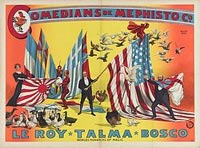
The Flags of All Nations

The Magic Detective is up to his old tricks, actually NEW old tricks. Over these past several months you may have noticed my absence from the blog. This is mainly due to my performing schedule. It's great to be busy! But along the way I luckily and happily stumbled upon a great opportunity. I'm currently working to recreate part of the act of a magician from the past and I'll be presenting it in the Fall.

The act I'm working on is a silk/flag/ribbon act. The key feature of the act is something known as The Flags of All Nations. This was apparently the creation of Johann Hofzinser. Yes, he created more than just card tricks. From what I've found his version was called 'The Patriot'.

It's been a lot of fun digging up information on this old gem. I have also found it in the book, The Modern Conjurer by C. Lang Neil, simply called The Flag Trick, but this book also mentions it was known by other names such as 'The Congress of Nations' and 'The Multiplying Flags'. It was a popular routine in the Victorian era and early 20th Century. And it evolved over time into a very elaborate series of productions.

In it's simplest form it began as several small flags that vanished or transformed into colored ribbons. From the ribbons larger flags would be produced and eventually a giant flag and flagpole! It seems that each performer added his own touches to the routine.

Who performed this trick?  Hofzinser, Eugene Laurant. Edward Maro, David Devant, Karl Germain, LeRoy, Talma and Bosco, J.B. Bobo, and even Harry Blackstone Sr. had a unique twist on the concept. It must have been an extremely popular effect because the trick is featured on a number of stock magic posters.


The Flags of All Nations isn't really made anymore. There have been some small reproductions of parts of the routines in the past, but I've not found the whole thing anywhere. Thankfully, by combing through my large library of historical magic books, I've been able to figure out where to find 'some' of the items required. My most recent acquisition were two Silk Fans which are spring loaded. In the photo above I'm holding the silk fans. These aren't flags, but they will do for what I need. I may end up having larger versions of this item made for the routine.

If you're wondering why this was such a popular routine well there are multiple reasons. People were flocking to the United States in droves during the late 19th Century and early 20th Century. They came here to become Americans, but had their roots in other lands. So when a magician produced a flag from the country of their origin it was exciting for them to see. And then when it concluded with the Stars and Stripes, well who would not be proud of that? The wonderful thing about the routine was it was easily adapted to whatever country you were in. For example, if you were in England, the final flag would not be the US Flag but the Union Jack. All the other components of the routine could remain the same but the final flag production would change to the country you were in.

Some performers had to learn the hard way about this. One magician was performing in Canada and finished with the US Flag. It actually got boos from the audience because at the time Canada and the US were involved in a trade dispute. So this magician changed the final flag to that of the Canadian National Flag and had much better results.

I venture to say that once I've finished all the research and found or built all the items, I'll be the only 21st Century magician performing this classic from yesteryear. I'll have more news on my 'recreation' of the act later in the Summer as well as info on whose act I'm recreating. For now, enjoy this image below of a magician who featured The Flags of All Nations (his was called The Flags of The World) prominently in his show.
In addition, check out the incredible Friedlander Stock Image here, and a small image of an incredible LeRoy, Talma and Bosco poster here.


Tuesday, August 19, 2014

Houdini's Brother Figures Prominently In Upcoming Auction

Theo Hardeen - Library of Congress Photo

August 23rd is only a couple days away. Potter and Potter Auction is holding a very special HOUDINIANA Auction. There are some incredible pieces in this auction. But one thing that really stands out to me is the amount of Hardeen material.

Theo 'Dash' Weiss, Houdini's brother was known as Hardeen. For many years he performed a similar act to Houdini. He never achieved the same fame as his brother, but he sure kept busy. He inherited all his brothers props upon the death of Houdini and according to the Will, all of this stuff was to be burnt/destroyed when Hardeen died. But it wasn't, THANKFULLY!

I'd like to focus on a couple of the Hardeen items, or the ones where Hardeen contributes something but were actually Houdini items. The first is a Letter Lock that Houdini was Challenged with. This is Lot#46 and has a estimated price of $7000/$9000. It comes with a letter from Hardeen and signed by Hardeen that explains where Houdini first got this lock. In 1905 Houdini was performing at the Alhambra Theatre in Paris when a spectator throws this lock on the stage and challenges Houdini to open it. Houdini says it would take too long but tells the spectator that if he can come backstage after the show, he will open it. This happens and Houdini opens the lock. However, you must read the full write up of the letter in the Potter and Potter Auction Catalog to find out the whole story. It's worth checking out!

Lot#51 is very interesting to me. It is a hand written letter describing a presentation for the escape from Bean Giant Handcuffs. The letter is front and back on Hardeen's stationary. Bean Giant cuffs, are extremely formidable cuffs because they are rigid. If they are placed on with the keyhole facing inwards towards the prisoner, they are virtually impossible to get out of even with the key. Houdini devised a method to escape from the Bean Giants and this was no doubt handed down to his brother Hardeen. I'd love to read this letter and find out what the routine was like.

Lot#53 A lot of 64 Letters to Sid Radner from Theo Hardeen. Can you imagine??? Wow, this is absolutely amazing. The wealth of information in these letters has got to be unreal! One of the things mentions, and I'm not sure I knew this, is that Hardeen had the Robert-Houdin Antonio Diavolo Automaton in his possession. Hardeen also mentions probably throwing away the apparatus for the Walking Through a Brick Wall due to this size and trouble with shipping. What??? There is so much to learn about Houdini and Hardeen from these letters. This is a real gem!

Lot#81 16mm Film of Hardeen's Overboard Packing Box Escape. It also comes with a digital DVD copy. I'm not sure this has every been seen. What an amazing piece of history, being able to see Hardeen in action!

Lot#187 Lithograph of Hardeen. This dates to 1908 and is probably cut out of a larger lithograph. I've never seen this image before so it might be the only surviving piece of a larger litho.

There are quite a few other Hardeen items in the auction, but the ones above are by far my personal favorites. Don't forget to register for the auction which begins this coming Saturday, Aug 23, 2014

Sunday, August 17, 2014

Houdini's Week in D.C. Feb 1912

(Library of Congress)
Houdini opened for a week at the Gayety Theater in Washington D.C. Feb 12, 1912. He would play the Gayety until Saturday Feb 17th. The Gayety Theater was located on 513 9th St. NW Washington, D.C. The Gayety opened in 1907 on the street known for it's theaters and nightlife.

According to an ad in the Washington Times on Feb 12, "Houdini-the Handcuff King, Who will perform astounding feats with locks, straitjackets, and handcuffs at every performance. The Original HOUDINI." The ad also mentioned that Houdini would perform twice a day, a matinee in the afternoon and then again in the evening.

Through newspaper records I've been able to track Houdini's performances for the week. It would appear that his opening on Monday Feb 12, he presented a number of feats and then let the audience know of the first 'challenge' for the week. This would take place on Tuesday evening Feb 13th. I will print exactly what it says in the newspaper ad.

"HOUDINI-the Handcuff King Has just been challenged to escape from an airtight galvanized iron tank into which he will be locked by the Jos. Schlitz Brewing Co., after they have filled it with beer. Tuesday Night"

So here is 'Challenge 1' and it's obvious that this one was orchestrated by Houdini. The 'airtight galvanized iron tank' is Houdini's Milk Can escape, but filled with beer rather than the usual water. And instead of hauling it out as his original invention, it's presented as a challenge from the Brewery.

On Feb 14th, Houdini is again challenged. Here is how reads the ad for the Gayety Theater promoting this escape.

"HOUDINI the Handcuff King, HOUDINI has been challenged by the Beacon Shoe Company. They will search him, rope him and nail him in a box they have built and out of which they wager he cannot escape."

Things get really interesting on Thursday Feb 15th. The Gayety takes out a larger ad, this time promoting ONLY Houdini. In addition, small articles on Houdini appear in two different newspapers. One of those articles is promoting his challenge for that evening. The other article is quite telling. The headline for this article reads "Houdini Does Magic For Newspaper Men". This time, rather than go to the newspapers office, he went to the National Press Club. He presented some card manipulations and tricks with cards and then finished with his famous Needle trick.  Houdini must have given this exhibition for the Press Club sometime in the afternoon. The National Press Club is only a couple blocks from where the Gayety Theater was located.

On Feb 15th, Houdini actually presented not one but two challenges. The afternoon challenge is by the Blacksmith Gussmans. The evening challenge is by the Seaman Gunners from the U.S. Navy Yard which again, is not too far from the theater. You can see that ad to the left.

On Friday Feb 16th, Houdini again gets a small article featuring his upcoming escape for that evening. In addition the two big papers in town both print ads similar to the one above featuring the details of that days challenges. In the afternoon, Houdini accepts the challenge made by a group of Sailmakers. They will tie his hands and feet behind his back with ropes soaked in rosin and tar, then place him in two of their specially made burlap bags. One to be fastened over head and the other tied at feet.

The evening challenge carries the headline "The Supreme Test of His Career-TONIGHT". The rest of the ad reads, " Insane asylum attendants will roll him in soaked wet sheets in mummy fashion, securely tie him down with broad bandages to a hospital bed, pour 20 buckets of water over him to shrink the knots, and he will attempt to release himself in FULL VIEW OF THE AUDIENCE".

Saturday Feb 17th is Houdini's final day at the Gayety in Washington D.C.. He gets yet another small article in the paper featuring his challenges. The article begins by saying that Houdini has been breaking all records at the Gayety this week. The two big papers again feature very large ads promoting the final challenges for the week. The matinee challenge will be from 'Spanish Inquisition Irons from war museums.'. And the final evening challenge of the week might sound familiar to some of you folks who know Houdini. The final challenge reads "Mechanic's Automobile Challenge - They will bind and lock Houdini in two inflated tires. They guarantee not to choke him in locking his head to the tires." This is a duplication of the Weed Tire Challenge that he first performed in 1908.

There you go, a week in the career of Harry Houdini Feb 12-17, 1912 Washington D.C.

Inside the Gayety Theatre - Library of Congress Photo

The information for this article was gathered from the Washington Times Newspaper and The Washington Herald Newspaper from 1912.


Friday, May 16, 2014

Remembering The Passing of the Mantle of Magic


Today marks the 106th Anniversary of the Passing of the Mantle of Magic from Harry Kellar to Howard Thurston at the Fords Theatre in Baltimore MD. May 16, 1908 in Howard Thurston's own words,
"Before the final curtain had fallen Kellar led me to the foot- lights and in a most touching speech briefly mentioned his own career of forty-five years as a public entertainer, and finished with a generous and affectionate prediction of my future. Kellar had played Ford's Opera House for many years. He handed his arm around my shoulders, while the orchestra played 'Auld Lang Syne'. As the ushers carried many floral offerings to the stage, the audience sang with the music. Finally, the musicians stood, then the entire audience was on its feet repeating the refrain. Leaning heavily on my shoulder as the curtain dropped for the last time, Kellar cried—so did I."
What was the Mantle of Magic? Essentially, it was nothing more than a business transaction between Kellar and Thurston. But that is too boring, so they put a theatrical spin to the whole affair and created this idea of passing Kellar's Mantle onto Thurston. For the 1907-08 Season, Kellar and Thurston toured the U.S. together.  All of the posters for the tour featured an image of Kellar's face in the upper corner and Thurston's face in the opposite corner. The final poster above, was the only one with a full sized image of both Thurston and Kellar, that I'm aware of.
I'm not sure how long Thurston continued using the Kellar endorsement after that iconic event. But it's clear he did continue to use "Kellar's Successor" for some time. 
Library of Congress Image
Today, all parties associated with the event are long gone. Thurston and Kellar have low since passed away. Even the Ford's Theatre in Baltimore is gone. But we have the posters, playbills and history to look back upon and fondly remember an important event in the annals of magic.


Sunday, February 9, 2014

The ULTIMATE Hofzinser Books - Review

The books are called Johann Nepomuk Hofzinser Non Plus Ultra, Volumes 1 & 2. Volume 1 is subtitled Magic of the 19th Century. Volume 2 is subtitled Hofzinser's Card Artistry. They have been written, researched and compiled by Magic Christian. Volume 1 originally was published in German in 1998. The second Volume followed in German in 2004. They were translated into English in 2013 and these are the books I proudly own and am carefully reviewing.

Non Plus Ultra. Interesting title for a book. It's Latin meaning Nothing Further Beyond, in other words, the Ultimate. I'd say, it's a fitting titled for these three books. What? Yes, I said three. There are 3 Volumes of Non Plus Ultra. The third was published in German in 2012 and covers all the apparatus and non card magic of Hofzinser. It is listed as 'forthcoming' so the English translation is being worked on and we will one day get to enjoy even more of Hofzinser's magic.

For now, there is much to learn about Hofzinser. Apparently, much of what has been written about the man biographically in the past was incorrect. Magic Christian has painstakingly set the record straight by correct every detail possible. Right off the bat, we find the correct date for Hofzinser's birth June 19, 1806.

Then we begin to learn of the rather larger Hofzinser family. It turns out that one of the siblings, Franz-Xaver Fidelis, was so famous in Austria that he is still recognized today in books on the most famous Austrians. His claim to fame was writing a very influential set of books on Light and Heavy Cavalry for the Military that had a profound effect on how horses were treated during military service.  There were several other siblings but they did not have note worthy lives.

Ludwig Doebler
One thing that does seem to remain true from previous histories of Hofzinser is his relationship to Ludwig Doebler. It is assumed they were cousins and more than likely Doebler was the inspiration for Hofzinser's interest in magic. Born in 1801 in Vienna, he was a few years older than Johann. Doebler was certainly a magic celebrity in his day. He even finds his way into many magic history books, where Hofzinser is often sadly neglected.

Doebler was an apparatus magician, as were many of his time. He also used the occasional automaton. The opening of his show was breathtaking, as he walked out and fired a pistol, instantly lighting 200+ candles. Another of his famous effects was producing hundreds of flower bouquets from an empty hat. One particular routine that intrigued me by Doebler was making borrowed objects vanish and reappear tied to the roots of plants and flowers. This very effect can be found in the beloved Tarbell Course, though it is attributed to someone who was born many years after Doebler had passed away. One other interesting note about Doebler that I found. One site claims he was referred to as The Father of Moving Pictures because of his unique use of multiple still images that would turn off and on to create the appearance of movement. THIS is something I'll need to look into for another article.

No doubt, the magic that Doebler performed was enough to spark the interest in his young cousin, Johann. Volume 1 clearly states that the very early years of Hofzinser's life are unknown or as yet uncovered. But they do an incredible job of tracing his life once he get's into school and then into job as a civil servant in the Viennese Government. Job records still exist on Hofzinser's work life right up until his retirement and Magic Christian did an amazing job to uncover them. But I wish to skip this section and get to the meat of things, The Salons.

The first revelation you'll find is that Magic Christian has uncovered information showing the Hofzinser was not the first magician in Vienna to open a magic salon. There were two prominent magi who beat him to it and you must read the book to find out who they were. It was interesting to read that the whole idea of the Salon was used by many more artists and entertainers than just magicians and was in fact, an important place for prominent individuals to attend and to be seen.

One of the first things we see in regards to the Hofzinser Salon shows was that his wife performed in the show as well. Johann presented card miracles while she presented clairvoyant demonstrations. The papers of the time noted how advanced their magic seemed as compared to those who used mechanical devices. But remember, the mechanical automaton and gimmicked apparatus were signature routines from this time period. So the Hofzinser's were offering something very different in the eyes of the public.

J.N. Hofzinser
His early show had the title of "An Evening of Deception". A rather ordinary name for today, but as Magic Christian points out, Hofzinser was the first to use it. And he kept this name for his show as he later left the Salon performances and took his show in the road, after his retirement from his government job. The book goes into great detail about his travels and follows with many reprints of newspaper articles. Most of the reviews are kind and generous but one in particular stood out at me. The review though complimentary at first changed it's tune due to the high admission price charged and then further went to calculate the amount the Hofzinser made at a performance and how this price was far more than a conjurer should be making. And again, as Magic Christian points out, the same sort of mind set can still be found today.

Volume 1 covers Hofzinser's entire life, his death, burial and then his students, his letter and his contemporaries. It is so comprehensive, I can't help but wish that every biography of a magician was so thorough.

Getting into Volume 2 however is just a mind bending affair. Whereas Volume 1 was history and mostly newly uncovered history of Hofzinser. Volume 2 gets into his card magic. I'm not even sure I can describe it and do it justice.

One of the first things I turned to when I was first just browsing through the volume was a section on what we know of today as the Electric Deck. It is a site gag used by poor performers basically and generally used for a cheap laugh. Or so I thought. Hofzinser's use of the Electric Deck is a huge wake up call to the modern magician. Here, Hofzinser shows how by switching a real Deck for an Electric Deck, one can create some highly incredible flourishes that all appear to happen with an ordinary pack of cards. OMG, it's BRILLIANT!

But there's more. Imagine my own surprise, shock even, to learn that one of Hofzinser's prized possessions resides only  25 miles from me. It's Hofzinser's Card Box, and again, if you think you know the Card Box, well, it's time you got reeducated like I did. The Hofzinser Card Box is made of metal, and it's round and it's INCREDIBLE! Oh, and it resides at the Library of Congress in Washington D.C.. So I'll be making an appointment fairly soon to go check it out for myself.

The shear amount of card material in this Volume is just mind blowing. Magic Christian again, goes to great lengths to clarify the proper handling of card moves, the history of these routines, the back story, he covers it all. Magic Christian also has no problem with setting the record straight when it comes to what Hofzinser created and what he has been credited with creating but wasn't his. For example, Johann has been credited with discovering or inventing the Rough and Smooth Principle for cards. But Magic Christian shows how this technique existed before Hofzinser and even goes to show how he was mis-credited in the first place.

I must point out another effect that is in Volume 2 and that is the Card Star. I had heard that Hofzinser created the Card Star but as I read the description, I realized that his Card Star was very different from what I called a Card Star. His, was a metal star with points on the ends to which cards could be attached. Then a pointer was placed in the center of the star and spun and it would land upon the correctly chosen card. The reason I point it out is that I am adding a Spirit Dial to one of my shows. I've used it many times in the past and out of no where came up with what I thought would be a great final sequence to the routine. My idea was to add playing cards to the edges of the glass and spin the dial to have it land on a previously chosen card........YES, my idea was almost identical to the routine described in the book! In no way do I claim to have the mind or even the mindset of Johann Hofzinser, but it was a nice coincidence. Hofzinser's Card Star was more like the Spirit Dial in methodology. The 'other' Card Star was a five pointed star mounted on a pedestal. Five cards are chosen and returned to the deck and the deck is then 'sprung' towards the Card Star and the five selections appear on the points of the star. This apparently was not a creation of Hofzinser.

I'll be completely honest, I've not yet finished reading Volume 2. The richness of material in this book is just not something you can go through quickly.  Volume 2 has so much material, sleights, flourishes, gaffed and gimmicked cards, none gimmicked routines, card routines with apparatus and more. It's just overwhelming to try and go through it quickly. This material needs to be taken in slowly and carefully. I'll tell you this, you simply can never get this amount of detail in a DVD, ever! Johann Hofzinser was a genius. Magic Christian truly has created the Non Plus Ultra (The ULTIMATE) work on Hofzinser, and there is still a third Volume yet to come out!!!! If you love magic history you have to have these books. If you are a performer in search of killer material you have to have these books. If you call yourself a magician and you DON'T have these books, you might want to reconsider that title. Go purchase these books before they are gone! 900 sets will be sold. Don't wait, get them now. Conjuring Arts has a deal whereby you can make monthly payments on the books, so you don't have an excuse not to get them!!!!  http://shop.conjuringarts.org/store/pc/Hofzinser-c143.htm

The only thing I can add is the magic world owes a huge debt of gratitude to Magic Christian for these remarkable books! Thank you!!!!!